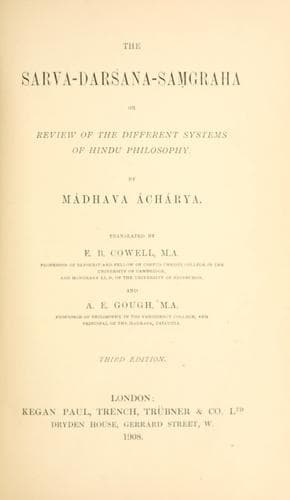
The Sarva-Darsana-Samgraha: Or, Review of the Different Systems of Hindu PhilosophyMadhava
ReligionEastern
The Sarva-Darsana-Samgraha: Or, Review of the Different Systems of Hindu Philosophy
Madhava
Philosophy, Hindu; Philosophy, Indic
[Footnote 380: This is the Mímáṃsá rule for settling the relative
value of the proofs that one thing is ancillary to another. 1.
_Śruti_, "a definite text," as "let him offer with curds," where curds
are clearly an ancillary part of the sacrifice. 2. _Liṅga_, "a sign,"
or "the sense of the words," as leading to an inference, as in the
text "he divides by the ladle;" here we infer that the thing to be
divided must be a liquid like ghee, since a ladle could not divide
solid things like the baked flour cakes. 3. _Vákya_, "the being
mentioned in one sentence," _i.e._, the context, as in the text "'(I
cut) thee for food,' thus saying, he cuts the branch;" here the words
"(I cut) thee for food" are ancillary to the action of cutting; or in
the text, "I offer the welcome (oblation) to Agni," the words "the
welcome (oblation) to Agni," as they form one sentence with the words
"I offer," are ancillary to the act of offering. 4. _Prakaraṇa_, "the
subject-matter viewed as a whole, with an interdependence of its
parts," as in the _darśa-púrṇamása_ sacrifice, where the _prayája_
ceremonies, which have no special fruit mentioned, produce, as parts,
a mystic influence (_apúrva_) which helps forward that influence of
the whole by which the worshippers obtain heaven. Here the _prakaraṇa_
proves them to be ancillary. 5. _Sthána_ (or _krama_), "relative
position" or "order," as the recital of the hymn _Śundhadhvam_, &c.,
"Be ye purified for the divine work," in connection with the mention
of the _sánnáyya_ vessels, where this position proves that the hymn is
ancillary to the action of sprinkling those vessels. 6. _Samákhyá_,
"title;" thus the Yajur-veda is called the special book for the
_adhvaryu_ priests; hence in any rite mentioned in it they are _prima
facie_ to be considered as the priests employed. The order in the
aphorism represents the relative weight to be attached to each; the
first, _śruti_, being the most important; the last, _samákhyá_, the
least. Cf. Jaimini's Sútras, iii. 3, 14; _Mímáṃsáparibháshá_, pp. 8,
9.]
[Footnote 381: _I.e._, Yogi-Yájñavalkya, the author of the
_Yájñavalkya-gítá_. See Hall, _Bibl. Index_, p. 14; Aufrecht, _Bodl.
Catal._, p. 87 _b_.]
[Footnote 382: _Karman_ seems here used for _kriyâ_, which properly
belongs only to the body, as the soul is _drashṭṛi_.]
[Footnote 383: _Scil. samádhi_, or the restraining the mind and senses
to profound contemplation.]
[Footnote 384: _Scil._ "forbearance, religious observance, postures,
suppression of the breath, restraint, attention, contemplation, and
meditation (_samádhi_)."]
[Footnote 385: See Bhoja, Comm. iii. 3, _samyag ádhíyate mano yatra sa
samádhiḥ_.]
[Footnote 386: Thus, _e.g._, the antecedent non-existence and the
destruction of the pot are found in the two halves in which the pot
itself (the counter-entity to its own non-existence) resides by
intimate relation (_samaváya-sambandha_).]
[Footnote 387: I read _niroddhavyánám_ for _nirodhánám_.]
Public-domain text, read in full here on John Shaqi.
Reviews
Reviews
No reviews yet
Be the first to share your thoughts on this work.
Elsewhere in the archive
Join the Discussion
Join the discussion
Sign in to leave a comment or review.
Sign InorCreate an account