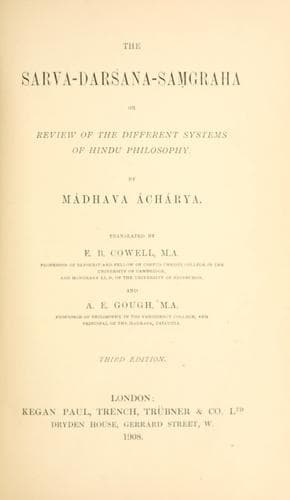
The Sarva-Darsana-Samgraha: Or, Review of the Different Systems of Hindu PhilosophyMadhava
ReligionEastern
The Sarva-Darsana-Samgraha: Or, Review of the Different Systems of Hindu Philosophy
Madhava
Philosophy, Hindu; Philosophy, Indic
[Footnote 388: _Chit-śakti_ and _chiti-śakti_ = soul.]
[Footnote 389: The _sattva_ of the _buddhi_ or the internal organ.]
[Footnote 390: This second substance, "mind" or "understanding"
(_buddhi_, _chitta_), is like a looking-glass, which reflects the
image of the object on a second looking-glass (_sc._ soul).]
[Footnote 391: Váchaspati explains _lakshaṇa_ as _kálabheda_.]
[Footnote 392: I take _ádi_ as meaning _asphuṭatva_. The change of state
takes place between the several moments of the _lakshaṇa-pariṇáma_. Cf.
the Commentaries on iii. 13.]
[Footnote 393: These are generally called the five states of the
thinking principle, _chittabhúmayas_ or _avasthás_. Cf. Commentary, i.
2, 18.]
[Footnote 394: These three conditions respectively characterise men,
demons, and gods.]
[Footnote 395: Much of this is taken from Bhoja's Commentary, and I
have borrowed Ballantyne's translation.]
[Footnote 396: Can _chitta_ mean "soul" here?]
[Footnote 397: _I.e._, as, _e.g._, whether the senses produce the
elements or the elements the senses, &c.]
[Footnote 398: In p. 164, line 4 _infra_, read _sukhaprakáśamayasya_.]
[Footnote 399: In p. 164, line 2 _infra_, read _sattámátra_ for
_sattva-_. Bhoja well distinguishes _asmitá_ from _ahaṃkára_.]
[Footnote 400: For these see _infra_, and cf. Yoga S., ii. 3, 12, 13.]
[Footnote 401: I have ventured to alter the examples, to suit the
English translation.]
[Footnote 402: Where the negation is prominent it is called
_prasajya-pratishedha_; but where it is not prominent, we have the
_paryudása_ negation. In the former the negative is connected with the
verb; in the latter it is generally compounded with some other word,
as, _e.g._--
(a.) "Not a drum was heard, not a funeral note."
(b.) "Unwatched the garden bough shall sway."
The former corresponds to the logician's _atyantábháva_, the latter to
_anyonyábháva_ or _bheda_.]
[Footnote 403: Cf. the _várttika_ in Siddhánta Kaum., i. 401.]
[Footnote 404: Thus _adhana_ stands for _avidya-mánadhana_, with
_vidyamána_ omitted in the compound.]
[Footnote 405: As its subject would confessedly be _buddhi_.]
[Footnote 406: As it is _avidyá_ after all.]
[Footnote 407: In p. 165, lines 16, 17, read (with my MS. of Váchaspati's
Gloss), _sarvavṛittinirodhasampannáyá api tathátvaprasaṅgát_.]
[Footnote 408: I read _tanvavastháścha_ with the printed edition of
Váchaspati's Gloss. If _tanudagdháścha_ is correct, it must mean
_tanutvena dagdháh_.]
[Footnote 409: As in _rámalakshmaṇau_, Ráma and Lakshmaṇa.]
[Footnote 410: I read _pakshatraye_ for _pakshadvaye_.]
[Footnote 411: In his Comm. on Sút., ii. 5.]
[Footnote 412: Thus _inimicus_ is not a "friend," nor, on the other
hand, a "non-friend," but something positive, an "enemy." So
_agoshpada_ is said to mean "a forest."]
[Footnote 413: Cf. Yoga Sút., i. 8.]
[Footnote 414: In p. 166, line 4 _infra_, read _káyádau_ for
_káryádau_.]
Public-domain text, read in full here on John Shaqi.
Reviews
Reviews
No reviews yet
Be the first to share your thoughts on this work.
Elsewhere in the archive
Join the Discussion
Join the discussion
Sign in to leave a comment or review.
Sign InorCreate an account