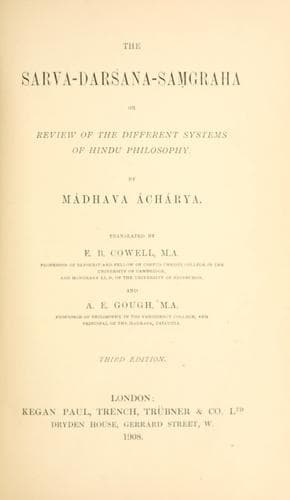
The Sarva-Darsana-Samgraha: Or, Review of the Different Systems of Hindu PhilosophyMadhava
ReligionEastern
The Sarva-Darsana-Samgraha: Or, Review of the Different Systems of Hindu Philosophy
Madhava
Philosophy, Hindu; Philosophy, Indic
[Footnote 415: This couplet is quoted by Vyása in his Comm. on Yoga
Sútras, ii. 5, and I have followed Váchaspati in his explanation of
it; he calls it _vaiyásakí gáthá_.]
[Footnote 416: Since the continued enjoyment of an object only
increases the desire for more, and its loss gives correspondent regret
(cf. Bhag. G. xviii. 38).]
[Footnote 417: Literally, "it has four feet."]
[Footnote 418: Thus "sight," or the power of seeing, is a modification
of the quality of _sattva_ unobstructed by _rajas_ and _tamas_.]
[Footnote 419: "Let the affix _ṇini_ be used after a root in the sense
of what is habitual, when the _upapada_, or subordinate word, is not a
word meaning 'genus' and ends in a case."]
[Footnote 420: "Let _vṛiddhi_ be the substitute of a base ending in a
vowel, when that which has an indicatory _ñ_ or _ṇ_ follows;" _ṇini_
has an indicatory _ṇ_.]
[Footnote 421: Sc. _anuśaya_ + _ini_ = _anuśayin_.]
[Footnote 422: _Ini_ and _ṭhan_, which respectively leave _in_ and
_ika_; thus _daṇḍa_ gives _daṇḍin_ and _daṇḍika_. The line is quoted
by Boehtlingk, vol. ii. p. 217, on Páṇ. v. 2, 115, and is explained in
the _Káśiká_, _ad loc_. The different prohibitions are illustrated by
the examples:--(1.) _svaván_, _khaván_; (2.) _kárakaván_; (3.)
_vyághraván_, _siṃhaván_; (4.) _daṇḍavatí śálá_ (_i.e._, _daṇḍá asyáṃ
santi_).]
[Footnote 423: By iii. 3, 56.]
[Footnote 424: It is curious to see the great grammarian's favourite
study obtruding itself here on such a slender pretext.]
[Footnote 425: See the _Káśiká_ on Páṇ. v. 2, 115. For _vivakshártha_
(meaning "general currency"), compare Commentary on Páṇ. ii. 2, 27.
The edition in the Benares _Pandit_ reads _vishayaniyamártha_.]
[Footnote 426: _i.e._, Thus _nirodha_ is not _vṛitter abhávaḥ_, but
_abhávasyáśryaḥ_.]
[Footnote 427: I read in p. 168, last line,
_prakáśapravṛittiniyamarúpa_, from Bhoja's comment on i. 12.]
[Footnote 428: See Káśiká, ii. 3, 36.]
[Footnote 429: This passage probably occurs in the _Yájñavalkya-gítá_
of Yogi-yájñavalkya. See Colebrooke's Essays (ed. 2), vol. i. p. 145,
note.]
[Footnote 430: Mímáṃsá Sútras, ii. 1, 35-37.]
[Footnote 431: The tantras are not properly concerned with what is
_nitya_ or _naimittika_; they are _kámya_.]
[Footnote 432: The _víja_ of air is the syllable _jaṃ_.]
[Footnote 433: The _víja_ of water is the syllable _baṃ_.]
[Footnote 434: _Hríṃ._]
[Footnote 435: _Śríṃ._]
[Footnote 436: _Táṇḍava_ is the frantic dance of the god. Śiva and his
votaries.]
[Footnote 437: Literally "they take severally in order the gender of
one of the two." Cf. "Thebæ ipsæ quod Bœotiæ caput est," _Livy_, xlii.
44; "Animal hoc providum, acutum, plenum rationis et consilii, quem
vocamus hominem," _Cic._, _Legg_, i. 7.]
[Footnote 438: I have borrowed these terms from Ballantyne's
translation of the Sáhitya-darpaṇa.]
Public-domain text, read in full here on John Shaqi.
Reviews
Reviews
No reviews yet
Be the first to share your thoughts on this work.
Elsewhere in the archive
Join the Discussion
Join the discussion
Sign in to leave a comment or review.
Sign InorCreate an account