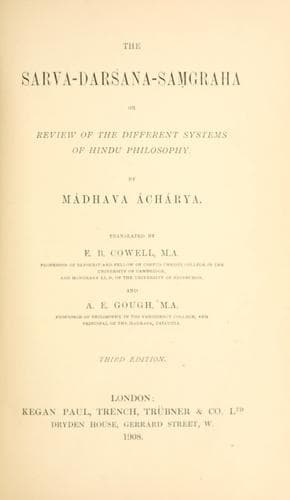
The Sarva-Darsana-Samgraha: Or, Review of the Different Systems of Hindu PhilosophyMadhava
ReligionEastern
The Sarva-Darsana-Samgraha: Or, Review of the Different Systems of Hindu Philosophy
Madhava
Philosophy, Hindu; Philosophy, Indic
[Footnote 439: Qualified indication arises from likeness, as the man
is like an ox from his stupidity; pure indication from any other
relation, as cause and effect, &c., thus butter is the cause of
longevity.]
[Footnote 440: _I.e._, an hour, a _ghaṭiká_ being twenty-four
minutes.]
[Footnote 441: The _náḍís_ or tubular vessels are generally reckoned
to be 101, with ten principal ones; others make sixteen principal
_náḍís_. They seem taken afterwards in pairs.]
[Footnote 442: Mádhava uses the same illustration in his commentary on the
passage in the Aitareya Bráhmaṇa (iii. 29), where the relation of the
vital airs, the seasons, and the mantras repeated with the offerings to
the seasons, is discussed. "The seasons never stand still; following each
other in order one by one, as spring, summer, the rains, autumn, the cold
and the foggy seasons, each consisting of two months, and so constituting
the year of twelve months, they continue revolving again and again like a
waterwheel (_ghaṭíyantravat_); hence the seasons never pause in their
course."]
[Footnote 443: This refers to a peculiar tenet of Hindu mysticism,
that each involuntary inspiration and expiration constitutes a mantra,
as their sound expresses the word _so'haṃ_ (i.e., _haṃsaḥ_), "I am
he." This mantra is repeated 21,600 times in every twenty-four hours;
it is called the _ajapámantra_, _i.e._, the mantra uttered without
voluntary muttering.]
[Footnote 444: _I.e._, that which conveys the inhaled and the exhaled
breath.]
[Footnote 445: I cannot explain this. We might read _guruvarṇánám_ for
_guṇavarṇánáṃ_, as the time spent in uttering a _guruvarṇa_ is a
_vipala_, sixty of which make a _pala_, and two and a half _palas_
make a minute; but this seems inconsistent with the other numerical
details. The whole passage may be compared with the opening of the
fifth act of the _Málatímádhava_.]
[Footnote 446: Sixty _palas_ make a _ghaṭiká_ (50 + 40 + 30 + 20 + 10
= 150, _i.e._, the _palas_ in two and a half _ghaṭikás_ or one hour).]
[Footnote 447: Cf. Colebrooke's Essays, vol. i. p. 256.]
[Footnote 448: Literally "the being ever more."]
[Footnote 449: For these colours cf. _Chhándogya Up._, viii. 6;
_Maitri Up._, vi. 30.]
[Footnote 450: This is an anonymous quotation in Vyása's Comm.]
[Footnote 451: This seems a variation of Śloka 7 of the _Amṛita-náda
Up._ See Weber, _Indische Stud._, ix. 26.]
[Footnote 452: This is defined in the Yoga Sút., iii. 4, as consisting
of the united operation towards one object of contemplation,
attention, and meditation.]
[Footnote 453: _I.e._, the internal organ (_chitta_).]
[Footnote 454: This couplet is corrupt in the text. I follow the
reading of the Bombay edition of the Puráṇa (only reading in line 3
_chalátmanám_).]
[Footnote 455: Vishṇu-pur., vi. 7, 45, with one or two variations. The
"perfect asylum" is Brahman, formless or possessing form.]
[Footnote 456: The old name for the central part of Bengal.]
Public-domain text, read in full here on John Shaqi.
Reviews
Reviews
No reviews yet
Be the first to share your thoughts on this work.
Elsewhere in the archive
Join the Discussion
Join the discussion
Sign in to leave a comment or review.
Sign InorCreate an account