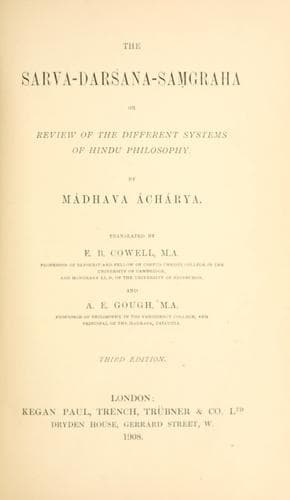
The Sarva-Darsana-Samgraha: Or, Review of the Different Systems of Hindu PhilosophyMadhava
ReligionEastern
The Sarva-Darsana-Samgraha: Or, Review of the Different Systems of Hindu Philosophy
Madhava
Philosophy, Hindu; Philosophy, Indic
[Footnote 457: A country comprising Khandesh and part of Guzerat; it
is the Λαρικἡ of Ptolemy.]
[Footnote 458: In p. 178, l. 2, _infra_, read _pravṛitta_ for
_pravṛitti_. Cf. Yoga S., iii. 52 in Bhoja's Comm. (50 in Vyása's
Comm.)]
[Footnote 459: Read _vikaraṇabhávaḥ_; Váchaspati explains it as
"_videhánám indriyáṇáṃ karaṇabhávaḥ_."]
[Footnote 460: Vyása has _karaṇapañchakarúpajaya_; Váchaspati explains
_rúpa_ by _grahaṇádi_ (cf. iii. 47).]
[Footnote 461: I read in p. 179, l. 11, _vyava-sáyavyavaseyátmakánám_,
from Vyása's Comm.]
[Footnote 462: _I.e._, as past, present, or future.]
[Footnote 463: _Viśoká._]
[Footnote 464: This is explained by Váchaspati, "The latent
impressions produced by the states of the internal organ called
_vyutthána_ (when it is chiefly characterised by 'activity,' or
'darkness,' iii. 9) and _nirodha_ (when it is chiefly characterised by
the quality of 'goodness'), are absorbed in the internal organ itself;
this in 'egoism' (_asmitá_); 'egoism' in the 'merely once resolvable'
(_i.e._, _buddhi_); and _buddhi_ into the 'irresolvable' (_i.e._,
_prakṛiti_)." _Prakṛiti_ consists of the three 'qualities' in
equilibrium; and the entire creation, consisting of causes and
effects, is the development of these 'qualities' when one or another
becomes predominant.]
[Footnote 465: This curious passage occurs in the Taittiríya-Áraṇyaka
i. 11, 5. Mádhava in his Comment, there explains it of the soul, and
quotes the Śvetáśv. Up., iii. 19. Mádhava here takes _avindat_ as "he
pierced the jewel," but I have followed his correct explanation in the
Comm.]
[Footnote 466: This is taken from Váchaspati's Comm. on Yoga S. ii.
15. Cf. the "four truths" of Buddhism.]
[Footnote 467: This probably refers to the Pañchadaśí. A Calcutta
Pandit told me that it referred to the Prameya-vivaraṇa-saṅgraha (cf.
Dr. Burnell's preface to his edition of the Devatádhyáya-bráhmaṇa, p.
x), but, if this is the same as the vivaraṇa-prameya-saṅgraha, it is
by Bháratítírthavidyáraṇya (see Dr. Burnell's Cat of Tanjore MSS. p.
88).]
APPENDIX.
ON THE UPÁDHI (cf. _supra_, pp. 7, 8, 174, 194).
[As the _upádhi_ or "condition" is a peculiarity of Hindu logic which
is little known in Europe, I have added the following translation of
the sections in the Bháshá-parichchheda and the Siddhánta-muktávalí,
which treat of it.]
cxxxvii. _That which always accompanies the major term
(sádhya), but does not always accompany the middle (hetu),
is called the Condition (upádhi); its examination is now set
forth._
Public-domain text, read in full here on John Shaqi.
Reviews
Reviews
No reviews yet
Be the first to share your thoughts on this work.
Elsewhere in the archive
Join the Discussion
Join the discussion
Sign in to leave a comment or review.
Sign InorCreate an account