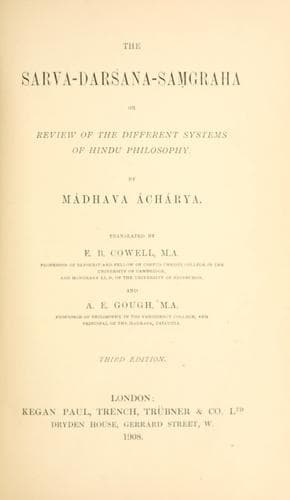
The Sarva-Darsana-Samgraha: Or, Review of the Different Systems of Hindu PhilosophyMadhava
ReligionEastern
The Sarva-Darsana-Samgraha: Or, Review of the Different Systems of Hindu Philosophy
Madhava
Philosophy, Hindu; Philosophy, Indic
The _jívas_ (souls) are divided into two, the "mundane" and the
"released." The "mundane" pass from birth to birth; and these are also
divided into two, as those possessing an internal sense (_samanaska_),
and those destitute of it (_amanaska_). The former possesses _saṃjñá_,
_i.e._, the power of apprehension, talking, acting, and receiving
instruction; the latter are those without this power. These latter are
also divided into two, as "locomotive" (_trasa_), or "immovable"
(_sthávara_).
The "locomotive" are those possessing at least two senses [touch and
taste], as shell-fish, worms, &c., and are thus of four kinds [as
possessing two, three, four, or five senses]; the "immovable" are
earth, water, fire, air, and trees.[69] But here a distinction must be
made. The dust of the road is properly "earth," but bricks, &c., are
aggregated "bodies of earth," and that soul by whom this body is
appropriated becomes "earthen-bodied," and that soul which will
hereafter appropriate it is the "earth-soul." The same four divisions
must also be applied to the others, water, &c. Now the souls which
have appropriated or will appropriate the earth, &c., as their bodies,
are reckoned as "immovable;" but earth, &c., and the "bodies of
earth," &c., are not so reckoned, because they are inanimate.[70]
These other immovable things, and such as only possess the one sense
of touch, are considered as "released," since they are incapable of
passing into any other state of existence.
_Dharma_, _adharma_, and _ákáśa_ are singular categories [and not
generic], and they have not the attribute of "action," but they are
the causes of a substance's change of place.
_Dharma_, "merit," and _adharma_, "demerit," are well known. They
assist souls in progressing or remaining stationary in the universally
extended[71] sky [or ether] characterised by light, and also called
Lokákáśa; hence the presence of the category "merit" is to be inferred
from progress, that of "demerit" from stationariness. The effect of
_ákáśa_ is seen when one thing enters into the space previously
occupied by another.
Public-domain text, read in full here on John Shaqi.
Reviews
Reviews
No reviews yet
Be the first to share your thoughts on this work.
Join the Discussion
Join the discussion
Sign in to leave a comment or review.
Sign InorCreate an account