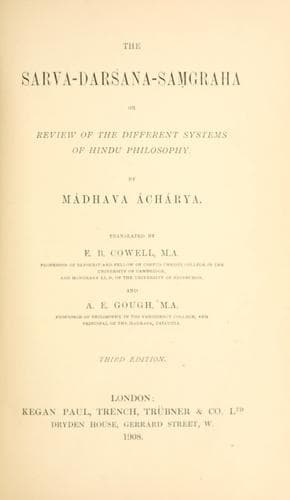
The Sarva-Darsana-Samgraha: Or, Review of the Different Systems of Hindu PhilosophyMadhava
ReligionEastern
The Sarva-Darsana-Samgraha: Or, Review of the Different Systems of Hindu Philosophy
Madhava
Philosophy, Hindu; Philosophy, Indic
Intelligence (_chaitanya_) is common to all souls, and is the real
nature of the soul viewed as _pariṇata_ [_i.e._, as it is in itself];
but by the influence of _upaśamakshaya_ and _kshayopaśama_ it appears
in the "mixed" form as possessing both,[62] or again, by the influence
of actions as they arise, it assumes the appearance of foulness,
&c.[63] As has been said by Váchakáchárya [in a sútra]--
"The _aupaśamika_, the _Ksháyika_, and the 'mixed' states are the
nature of the soul, and also the _audayika_ and the _Páriṇámika_."
1. The _aupaśamika_ state of the soul arises when all the effects of
past actions have ceased, and no new actions arise [to affect the
future], as when water becomes temporarily pure through the defiling
mud sinking to the bottom by the influence of the clearing
nut-plant,[64] &c.
2. The _Ksháyika_ state arises when there is the absolute abolition of
actions and their effects, as in final liberation.
3. The "mixed" (_miśra_) state combines both these, as when water is
partly pure.
4. The _audayika_ state is when actions arise [exerting an inherent
influence on the future]. The _Páriṇámika_ state is the soul's innate
condition, as pure intelligence, &c., and disregarding its apparent
states, as (1), (2), (3), (4).[65] This nature, in one of the
above-described varieties, is the character of every soul whether
happy or unhappy. This is the meaning of the sútra quoted above.
This has been explained in the _Svarúpa-sambodhana_--
"Not different from knowledge, and yet not identical with it,--in some
way both different and the same,--knowledge is its first and last;
such is the soul described to be."
If you say that, "As difference and identity are mutually exclusive,
we must have one or the other in the case of the soul, and its being
equally both is absurd," we reply, that there is no evidence to
support you when you characterise it as absurd. Only a valid
non-perception[66] can thus preclude a suggestion as absurd; but this
is not found in the present case, since (in the opinion of us, the
advocates of the _Syád-váda_) it is perfectly notorious that all
things present a mingled nature of many contradictory attributes.
Others lay down a different set of _tattvas_ from the two mentioned
above, _jíva_ and _ajíva_; they hold that there are five _astikáyas_
or categories,--_jíva_, _ákáśa_, _dharma_, _adharma_, and _pudgala_.
To all these five we can apply the idea of "existence" (_asti_),[67]
as connected with the three divisions of time, and we can similarly
apply the idea of "body" (_káya_),[68] from their occupying several
parts of space.
Public-domain text, read in full here on John Shaqi.
Reviews
Reviews
No reviews yet
Be the first to share your thoughts on this work.
Join the Discussion
Join the discussion
Sign in to leave a comment or review.
Sign InorCreate an account