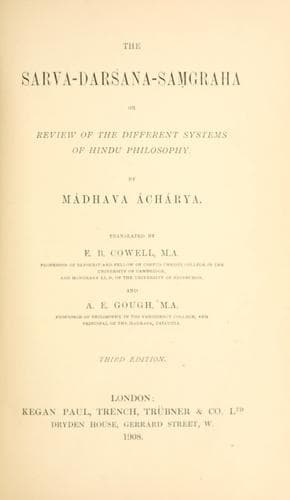
The Sarva-Darsana-Samgraha: Or, Review of the Different Systems of Hindu PhilosophyMadhava
ReligionEastern
The Sarva-Darsana-Samgraha: Or, Review of the Different Systems of Hindu Philosophy
Madhava
Philosophy, Hindu; Philosophy, Indic
[Footnote 5: Dr. A. C. Burnell, in his preface to his edition of the
Vaṃśa-Bráhmaṇa, has solved the riddle of the relation of Mádhava and
Sáyaṇa. Sáyaṇa is a pure Draviḍian name given to a child who is born
after all the elder children have died. Mádhava elsewhere calls Sáyaṇa
his "younger brother," as an allegorical description of his body,
himself being the eternal soul. His use of the term Sáyaṇa-Mádhavaḥ
here (not the dual) seems to prove that the two names represent the
same person. The body seems meant by the Sáyaṇa of the third śloka.
Máyaṇa was the father of Mádhava, and the true reading may be
_śríman-máyaṇa_.]
CHAPTER I.
THE CHÁRVÁKA SYSTEM.
[We have said in our preliminary invocation "salutation to Śiva, the
abode of eternal knowledge, the storehouse of supreme felicity,"] but
how can we attribute to the Divine Being the giving of supreme
felicity, when such a notion has been utterly abolished by Chárváka,
the crest-gem of the atheistical school, the follower of the doctrine
of Bṛihaspati? The efforts of Chárváka are indeed hard to be
eradicated, for the majority of living beings hold by the current
refrain--
While life is yours, live joyously;
None can escape Death's searching eye:
When once this frame of ours they burn,
How shall it e'er again return?
The mass of men, in accordance with the Śástras of policy and
enjoyment, considering wealth and desire the only ends of man, and
denying the existence of any object belonging to a future world, are
found to follow only the doctrine of Chárváka. Hence another name for
that school is Lokáyata,--a name well accordant with the thing
signified.[6]
In this school the four elements, earth, &c., are the original
principles; from these alone, when transformed into the body,
intelligence is produced, just as the inebriating power is developed
from the mixing of certain ingredients;[7] and when these are
destroyed, intelligence at once perishes also. They quote the Śruti
for this [Bṛihad Áraṇy. Up. ii. 4, 12], "Springing forth from these
elements, itself solid knowledge, it is destroyed when they are
destroyed,--after death no intelligence remains."[8] Therefore the
soul is only the body distinguished by the attribute of intelligence,
since there is no evidence for any soul distinct from the body, as
such cannot be proved, since this school holds that perception is the
only source of knowledge and does not allow inference, &c.
Public-domain text, read in full here on John Shaqi.
Reviews
Reviews
No reviews yet
Be the first to share your thoughts on this work.
Join the Discussion
Join the discussion
Sign in to leave a comment or review.
Sign InorCreate an account