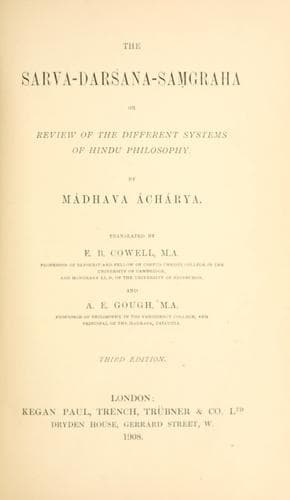
The Sarva-Darsana-Samgraha: Or, Review of the Different Systems of Hindu PhilosophyMadhava
ReligionEastern
The Sarva-Darsana-Samgraha: Or, Review of the Different Systems of Hindu Philosophy
Madhava
Philosophy, Hindu; Philosophy, Indic
The only end of man is enjoyment produced by sensual pleasures. Nor
may you say that such cannot be called the end of man as they are
always mixed with some kind of pain, because it is our wisdom to enjoy
the pure pleasure as far as we can, and to avoid the pain which
inevitably accompanies it; just as the man who desires fish takes the
fish with their scales and bones, and having taken as many as he
wants, desists; or just as the man who desires rice, takes the rice,
straw and all, and having taken as much as he wants, desists. It is
not therefore for us, through a fear of pain, to reject the pleasure
which our nature instinctively recognises as congenial. Men do not
refrain from sowing rice, because forsooth there are wild animals to
devour it; nor do they refuse to set the cooking-pots on the fire,
because forsooth there are beggars to pester us for a share of the
contents. If any one were so timid as to forsake a visible pleasure,
he would indeed be foolish like a beast, as has been said by the
poet--
The pleasure which arises to men from contact with sensible objects,
Is to be relinquished as accompanied by pain,--such is the reasoning
of fools;
The berries of paddy, rich with the finest white grains,
What man, seeking his true interest, would fling away because covered
with husk and dust?[9]
If you object that, if there be no such thing as happiness in a future
world, then how should men of experienced wisdom engage in the
agnihotra and other sacrifices, which can only be performed with great
expenditure of money and bodily fatigue, your objection cannot be
accepted as any proof to the contrary, since the agnihotra, &c., are
only useful as means of livelihood, for the Veda is tainted by the
three faults of untruth, self-contradiction, and tautology;[10] then
again the impostors who call themselves Vaidic pundits are mutually
destructive, as the authority of the jñána-káṇḍa is overthrown by
those who maintain that of the karma-káṇḍa, while those who maintain
the authority of the jñána-káṇḍa reject that of the karma-káṇḍa; and
lastly, the three Vedas themselves are only the incoherent rhapsodies
of knaves, and to this effect runs the popular saying--
The Agnihotra, the three Vedas, the ascetic's three staves,
and smearing oneself with ashes,--
Bṛihaspati says, these are but means of livelihood for those
who have no manliness nor sense.
Public-domain text, read in full here on John Shaqi.
Reviews
Reviews
No reviews yet
Be the first to share your thoughts on this work.
Join the Discussion
Join the discussion
Sign in to leave a comment or review.
Sign InorCreate an account