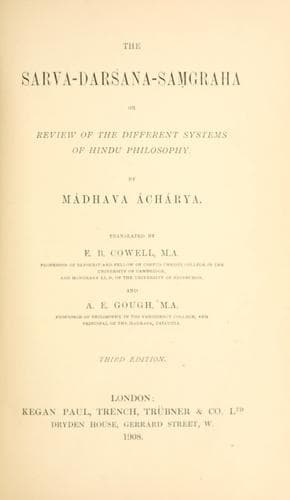
The Sarva-Darsana-Samgraha: Or, Review of the Different Systems of Hindu PhilosophyMadhava
ReligionEastern
The Sarva-Darsana-Samgraha: Or, Review of the Different Systems of Hindu Philosophy
Madhava
Philosophy, Hindu; Philosophy, Indic
"Hari, when propitiated by devotion in the form of
meditation,
"At once brings to a close that illusion which is the
aggregate of works.
"Then in souls the essential attributes, from which
transmigration has vanished,
"Are manifested, auspicious, omniscience, and the rest.
"These qualities are common to the emancipated spirits and
the Lord,
"Universal efficiency alone among them is peculiar to the
Deity.
"Emancipated spirits are ulterior to the infinite absolute,
which is unsusceptible of aught ulterior;
"They enjoy all beatitudes together with that Spirit."
It is therefore stated that those who suffer the three kinds of pain
must, for the attainment of immortality, investigate the absolute
spirit known under such appellations as the Highest Being. According
to the maxim: The base and the suffix convey the meaning conjointly,
and of these the meaning of the suffix takes the lead, the notion of
desire is predominant (in the word _jijñásitavya_), and desired
knowledge is the predicate (in the aphorism, Then hence the absolute
must be desired to be known). Knowledge is cognition designated by
such terms as meditation, devotion; not the merely superficial
knowledge derived from verbal communication, such being competent to
any one who hears a number of words and understands the force of each,
even without any predication; in conformity with such Vedic texts as:
Self indeed it is that is to be seen, to be heard, to be thought, to
be pondered; He should meditate that it is self alone; Having known,
let him acquire excellent wisdom; He should know that which is beyond
knowledge. In these texts "to be heard" is explanatory, hearing being
understood (but not enounced) in the text about sacred study (viz.,
_shaḍaṅgena vedo'dhyeyo jñeyaścha_, the Veda, with its six appendages,
is to be studied and known); so that a man who has studied the Veda
must of his own accord, in acquiring the Veda and its appendages,
engage in "hearing," in order to ascertain the sense by examining it
and the occasion of its enouncement. The term "to be thought" (or "to
be inferred") is also explanatory, cogitation (or inference) being
understood as the complementary meaning of hearing, according to the
aphorism: Before its signification is attained the system is
significant. Meditation is a reminiscence consisting of an unbroken
succession of reminiscences like a stream of oil, it being revealed in
the text, in continuity of reminiscence there is a solution of all
knots,--that it is unintermittent reminiscence that is the means of
emancipation. And this reminiscence is tantamount to intuition.
"Cut is his heart's knot, solved are all his doubts,
"And exhausted are all his works, when he has seen the
Highest and Lowest,"
Public-domain text, read in full here on John Shaqi.
Reviews
Reviews
No reviews yet
Be the first to share your thoughts on this work.
Elsewhere in the archive
Join the Discussion
Join the discussion
Sign in to leave a comment or review.
Sign InorCreate an account