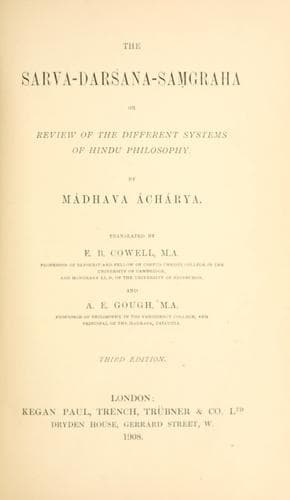
The Sarva-Darsana-Samgraha: Or, Review of the Different Systems of Hindu PhilosophyMadhava
ReligionEastern
The Sarva-Darsana-Samgraha: Or, Review of the Different Systems of Hindu Philosophy
Madhava
Philosophy, Hindu; Philosophy, Indic
because he becomes one with that Supreme. So also in the words, Self
indeed is to be seen, it is predicated of this reminiscence that it is
an intuition. Reminiscence becomes intuitional through the vivacity of
the representations. The author of the Vákya has treated of all this
in detail in the passage beginning Cognition is meditation. The
characters of this meditation are laid out in the text: This soul is
not attainable by exposition, nor by wisdom, nor by much learning;
Whom God chooses by him God may be attained. To him this self unfolds
its own nature. For it is that which is dearest which is
choice-worthy, and as the soul finds itself most dear, so the Lord is
of Himself most dear, as was declared by the Lord Himself--
"To them always devoted, who worship me with love,
"I give the devotion of understanding whereby they come to
me."
And again--
"That Supreme Spirit, Arjuna, is attainable by faith
unwavering."
But devotion (or faith) is a kind of cognition which admits no other
motive than the illimitable beatitude, and is free from all other
desires; and the attainment of this devotion is by discrimination and
other means. As is said by the author of the Vákya: Attainment
thereof results from discrimination (_viveka_), exemption (_vimoka_),
practice (_abhyása_), observance (_kriyá_), excellence (_kalyáṇa_),
freedom from despondency (_anavasáda_), satisfaction (_anuddharsha_),
according to the equivalence (of the definition), and the explication
(of these terms). Of these means, discrimination is purity of nature,
resultant from eating undefiled food, and the explication (of
discrimination) is From purity of diet, purity of understanding, and
by purity of understanding the unintermittent reminiscence. Exemption
is non-attachment to sensuous desires; the explication being, Let the
quietist meditate. Practice is reiteration; and of this a traditionary
explication is quoted (from the Bhagavad-gítá) by (Rámánuja) the
author of the commentary: For ever modified by the modes thereof.
Observance is the performance of rites enjoined in revelation and
tradition according to one's ability; the explication being (the Vedic
text), He who has performed rites is the best of those that know the
supreme. The excellences are veracity, integrity, clemency, charity
(alms-giving), and the like; the explication being, It is attained by
veracity. Freedom from despondency is the contrary of dejection; the
explication being, This soul is not attained by the faint-hearted.
Satisfaction is the contentment which arises from the contrary of
dejection; the explication being, Quiescent, self-subdued. It has thus
been shown that by the devotion of one in whom the darkness has been
dispelled by the grace of the Supreme Spirit, propitiated by certain
rites and observances, which devotion is meditation transformed into a
presentative manifestation of soul, without ulterior motive, as
Public-domain text, read in full here on John Shaqi.
Reviews
Reviews
No reviews yet
Be the first to share your thoughts on this work.
Elsewhere in the archive
Join the Discussion
Join the discussion
Sign in to leave a comment or review.
Sign InorCreate an account