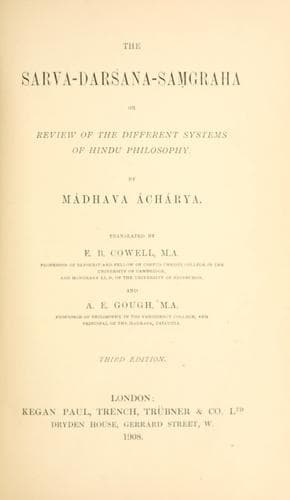
The Sarva-Darsana-Samgraha: Or, Review of the Different Systems of Hindu PhilosophyMadhava
ReligionEastern
The Sarva-Darsana-Samgraha: Or, Review of the Different Systems of Hindu Philosophy
Madhava
Philosophy, Hindu; Philosophy, Indic
incessantly and illimitably desired, the sphere of the Supreme Spirit
(Vaikuṇṭha) is attained. Thus Yámuna says: Attainable by the final and
absolute devotion of faith in one internally purified by both (works
and knowledge); that is, in one whose internal organ is rectified by
the devotion of works and knowledge.
In anticipation of the inquiry, But what absolute is to be desired to
be known? the definition is given (in the second aphorism). From which
the genesis, and so forth, of this. The genesis, and so forth, the
creation (emanation), sustentation, and retractation (of the
universe). The purport of the aphorism is that the emanation,
sustentation, and retractation of this universe, inconceivably
multiform in its structure, and interspersed with souls, from Brahmá
to a tuft of grass, of determinate place, time, and fruition, is from
this same universal Lord, whose essence is contrary to all qualities
which should be escaped from, of illimitable excellences, such as
indefeasible volition, and of innumerable auspicious attributes,
omniscient, and omnipotent.
In anticipation of the further inquiry, What proof is there of an
absolute of this nature? It is stated that the system of institutes
itself is the evidence (in the third aphorism): Because it has its
source from the system. To have its source from the system is to be
that whereof the cause or evidence is the system. The system, then, is
the source (or evidence) of the absolute, as being the cause of
knowing the self, which is the cause of knowing the absolute. Nor is
the suspicion possible that the absolute may be reached by some other
form of evidence. For perception can have no conversancy about the
absolute since it is supersensible. Nor can inference, for the
illation, the ocean, and the rest, must have a maker, because it is an
effect like a water-pot, is worth about as much as a rotten pumpkin.
It is evinced that it is such texts as, Whence also these elements,
that prove the existence of the absolute thus described.
Public-domain text, read in full here on John Shaqi.
Reviews
Reviews
No reviews yet
Be the first to share your thoughts on this work.
Elsewhere in the archive
Join the Discussion
Join the discussion
Sign in to leave a comment or review.
Sign InorCreate an account