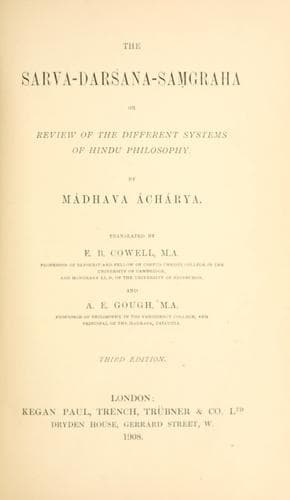
The Sarva-Darsana-Samgraha: Or, Review of the Different Systems of Hindu PhilosophyMadhava
ReligionEastern
The Sarva-Darsana-Samgraha: Or, Review of the Different Systems of Hindu Philosophy
Madhava
Philosophy, Hindu; Philosophy, Indic
Though the absolute (it may be objected) be unsusceptible of any other
kind of proof, the system, did it not refer to activity and cessation
of activity, could not posit the absolute aforesaid. To avoid by
anticipation any queries on this point, it is stated (in the fourth
aphorism): But that is from the construction. This is intended to
exclude the doubt anticipated. The evidence, then, of the system is
the only evidence that can be given of the absolute. Why? Because of
the construction, that is because the absolute, that is, the highest
end for man, is construed as the subject (of the first aphorism, viz.,
Then thence the absolute is to be desired to be known). Moreover, a
sentence which has nothing to do either with activity or with
cessation of activity is not therefore void of purpose, for we observe
that sentences merely declaratory of the nature of things, such as, A
son is born to you, This is not a snake, convey a purpose, viz., the
cessation of joy or of fear. Thus there is nothing unaccounted for. We
have here given only a general indication. The details may be learnt
from the original (viz., Rámánuja's Bháshya on the Vedánta aphorisms);
we therefore decline a further treatment, apprehensive of prolixity;
and thus all is clear.[110]
A. E. G.
FOOTNOTES:
[Footnote 107: Cf. "The argument in defence of the Maxim of
Contradiction is that it is a postulate employed in all the particular
statements as to matters of daily experience that a man understands
and acts upon when heard from his neighbours; a postulate such that,
if you deny it, no speech is either significant or trustworthy to
inform and guide those who hear it. You may cite innumerable examples
both of speech and action in the detail of life, which the
Herakleitean must go through like other persons, and when, if he
proceeded upon his own theory, he could neither give nor receive
information by speech, nor ground any action upon the beliefs which he
declares to co-exist in his own mind. Accordingly the Herakleitean
Kratylus (so Aristotle says) renounced the use of affirmative speech,
and simply pointed with his finger."--Grote's Aristotle, vol. ii. pp.
297, 298.]
[Footnote 108: Cf. the dictum of Herakleitus: Making worlds is Zeus's
pastime; and that of Plato (Laws, Book vii. p. 803): Man is made to be
the plaything of God.]
[Footnote 109: "Whose body nature is, and God the soul."--_Pope._]
[Footnote 110: For further details respecting Rámánuja and his system,
see Wilson's Works, vol. i. pp. 34-46; and Banerjea's Dialogues, ix.
The _Tattva-muktávalí_ was printed in the _Pandit_ for September 1871;
but the lines quoted in p. 73 are not found there.]
CHAPTER V.
THE SYSTEM OF PURNA-PRAJNA.
Public-domain text, read in full here on John Shaqi.
Reviews
Reviews
No reviews yet
Be the first to share your thoughts on this work.
Elsewhere in the archive
Join the Discussion
Join the discussion
Sign in to leave a comment or review.
Sign InorCreate an account