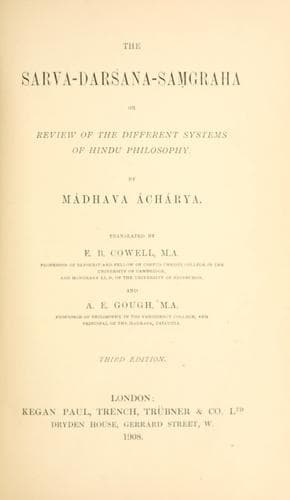
The Sarva-Darsana-Samgraha: Or, Review of the Different Systems of Hindu PhilosophyMadhava
ReligionEastern
The Sarva-Darsana-Samgraha: Or, Review of the Different Systems of Hindu Philosophy
Madhava
Philosophy, Hindu; Philosophy, Indic
Ánanda-tírtha (Púrṇa-prajña, or Madhva) rejected this same Rámánuja
system, because, though like his own views, it teaches the atomic size
of the soul, the servitude of the soul, the existence of the Veda
without any personal author, the authenticity of the Veda, the
self-evidence of the instruments of knowledge, the triad of evidences,
dependency upon the Pañcha-rátra, the reality of plurality in the
universe, and so forth,--yet, in accepting three hypotheses as to
reciprocally contradictory divisions, &c., it coincides with the
tenets of the Jainas. Showing that He is soul, That art thou, and a
number of other texts of the Upanishads bear a different import under
a different explanation, he set up a new system under the guise of a
new explication of the Brahma-Mímáṇsá (or Vedánta).
For in his doctrine ultimate principles are dichotomised into
independent and dependent; as it is stated in the Tattva-viveka:--
"Independent and dependent, two principles are received;
"The independent is Vishṇu the Lord, exempt from
imperfections, and of inexhaustible excellences."
Here it will be urged (by the Advaita-vádins): Why predicate of the
absolute these inexhaustible excellences in the teeth of the Upanishads,
which lay down that the absolute principle is void of homogeneity and
heterogeneity, and of all plurality in itself? To this be it replied: Not
so, for these texts of the Upanishads, as contradictory of many proofs
positive of duality, cannot afford proof of universal unity; perception,
for example, in the consciousness, This is different from that, pronounces
a difference between things, blue and yellow, and so forth. The opponent
will rejoin: Do you hold that perception is cognisant of a perceptional
difference, or of a difference constituted by the thing and its opposite?
The former alternative will not hold: for without a cognition of the thing
and its opposite, the recognition of the difference, which presupposes
such a cognition, will be impossible. On the latter alternative it must be
asked, Is the apprehension of the difference preceded by an apprehension
of the thing and its contrary, or are all the three (the thing, its
contrary, and the contrariety) simultaneously apprehended? It cannot be
thus preceded, for the operation of the intellect is without delay (or
without successive steps), and there would also result a logical seesaw
(apprehension of the difference presupposing apprehension of the thing and
its contrary, and apprehension of the thing and its contrary presupposing
apprehension of the difference). Nor can there be a simultaneous
apprehension (of the thing, its contrary, and the difference); for
cognitions related as cause and effect cannot be simultaneous, and the
cognition of the thing is the cause of the recognition of the difference;
the causal relation between the two being recognised by a concomitance and
non-concomitance (mutual exclusion), the difference not being cognised
Public-domain text, read in full here on John Shaqi.
Reviews
Reviews
No reviews yet
Be the first to share your thoughts on this work.
Elsewhere in the archive
Join the Discussion
Join the discussion
Sign in to leave a comment or review.
Sign InorCreate an account