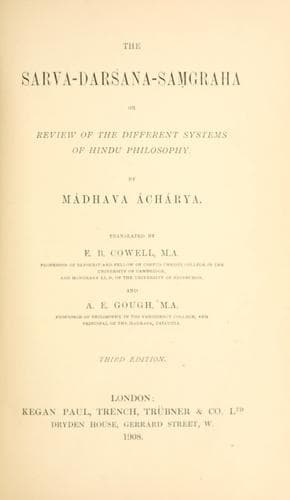
The Sarva-Darsana-Samgraha: Or, Review of the Different Systems of Hindu PhilosophyMadhava
ReligionEastern
The Sarva-Darsana-Samgraha: Or, Review of the Different Systems of Hindu Philosophy
Madhava
Philosophy, Hindu; Philosophy, Indic
even when the thing is present, without a cognition of its absent
contrary. The perception of difference, therefore (the opponent
concludes), is not easily admissible. To this let the reply be as
follows:--Are these objections proclaimed against one who maintains a
difference identical with the things themselves, or against one who
maintains a difference between things as the subjects of attributes? In
the former case, you will be, as the saying runs, punishing a respectable
Bráhman for the offence of a thief, the objections you adduce being
irrelevant. If it be urged that if it is the essence of the thing that is
the difference, then it will no longer require a contrary counterpart; but
if difference presuppose a contrary counterpart, it will exist everywhere;
this statement must be disallowed, for while the essence of a thing is
first known as different from everything else, the determinate usage (name
and notion) may be shown to depend upon a contrary counterpart; for
example, the essence of a thing so far as constituted by its dimensions is
first cognised, and afterwards it becomes the object of some determinate
judgment, as long or short in relation to some particular counterpart (or
contrasted object). Accordingly, it is said in the Vishṇu-tattva-nirṇaya:
"Difference is not proved to exist by the relation of determinant and
determinate; for this relation of determinant and determinate (or
predicate and subject) presupposes difference; and if difference were
proved to depend upon the thing and its counterpart, and the thing and its
counterpart to presuppose difference, difference as involving a logical
circle could not be accounted for; but difference is itself a real
predicament (or ultimate entity). For this reason (viz., because
difference is a _thing_) it is that men in quest of a cow do not act (as
if they had found her) when they see a gayal, and do not recall the word
_cow_. Nor let it be objected that (if difference be a real entity and as
such perceived) on seeing a mixture of milk and water, there would be a
presentation of difference; for the absence of any manifestation of, and
judgment about, the difference, may be accounted for by the force of (the
same) obstructives (as hinder the perception of other things), viz.,
aggregation of similars and the rest." Thus it has been said (in the
Sáṅkhya-káriká, v. vii.)--
"From too great remoteness, from too great nearness, from
defect in the organs, from instability of the common
sensory,
"From subtilty, from interposition, from being overpowered,
and from aggregation of similars."
Public-domain text, read in full here on John Shaqi.
Reviews
Reviews
No reviews yet
Be the first to share your thoughts on this work.
Elsewhere in the archive
Join the Discussion
Join the discussion
Sign in to leave a comment or review.
Sign InorCreate an account