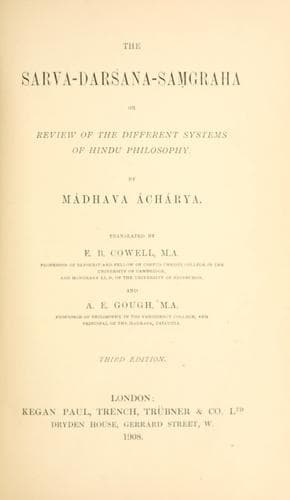
The Sarva-Darsana-Samgraha: Or, Review of the Different Systems of Hindu PhilosophyMadhava
ReligionEastern
The Sarva-Darsana-Samgraha: Or, Review of the Different Systems of Hindu Philosophy
Madhava
Philosophy, Hindu; Philosophy, Indic
There is no perception respectively of a tree and the like on the peak
of a mountain, because of its too great remoteness; of collyrium
applied to the eyes, and so forth, because of too great proximity; of
lightning and the like, because of a defect in the organs; of a jar or
the like in broad daylight, by one whose common sensory is bewildered
by lust and other passions, because of instability of the common
sensory; of an atom and the like, because of their subtility; of
things behind a wall, and so forth, because of interposition; of the
light of a lamp and the like, in the day-time, because of its being
overpowered; of milk and water, because of the aggregation of
similars.
Or let the hypothesis of difference in qualities be granted, and no
harm is done; for given the apprehension of a subject of attributes
and of its contrary, the presentation of difference in their modes is
possible. Nor let it be supposed that on the hypothesis of difference
in the modes of things, as each difference must be different from some
ulterior difference, there will result an embarrassing progression to
infinity, there being no occasion for the occurrence of the said
ulterior difference, inasmuch as we do not observe that men think and
say that two things are different as differenced from the different.
Nor can an ulterior difference be inferred from the first difference,
for there being no difference to serve as the example in such
inference, there cannot but be a non-occurrence of inference. And thus
it must be allowed that in raising the objection you have begged for a
little oil-cake, and have had to give us gallons of oil. If there be
no difference for the example the inference cannot emerge. The bride
is not married for the destruction of the bridegroom. There being,
then, no fundamental difficulty, this infinite progression presents no
trouble.
Difference (duality) is also ascertained by inference. Thus the
Supreme Lord differs from the individual soul as the object of its
obedience; and he who is to be obeyed by any person differs from that
person, a king, for instance, from his attendant. For men, desiring
as they do the end of man, Let me have pleasure, let me not have the
slightest pain, if they covet the position of their lord, do not
become objects of his favour, nay, rather, they become recipients of
all kinds of evil. He who asserts his own inferiority and the
excellence of his superior, he it is who is to be commended; and the
gratified superior grants his eulogist his desire. Therefore it has
been said:--
"Kings destroy those who assert themselves to be kings,
"And grant to those who proclaim their kingly pre-eminence
all that they desire."
Public-domain text, read in full here on John Shaqi.
Reviews
Reviews
No reviews yet
Be the first to share your thoughts on this work.
Elsewhere in the archive
Join the Discussion
Join the discussion
Sign in to leave a comment or review.
Sign InorCreate an account