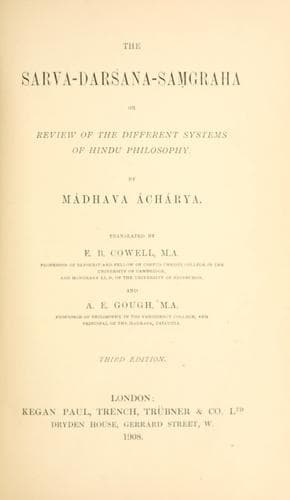
The Sarva-Darsana-Samgraha: Or, Review of the Different Systems of Hindu PhilosophyMadhava
ReligionEastern
The Sarva-Darsana-Samgraha: Or, Review of the Different Systems of Hindu Philosophy
Madhava
Philosophy, Hindu; Philosophy, Indic
Thus the statement of those (Advaita-vádins) in their thirst to be one
with the Supreme Lord, that the supreme excellence of Vishṇu is like a
mirage, is as if they were to cut off their tongues in trying to get a
fine plantain, since it results that through offending this supreme Vishṇu
they must enter into the hell of blind darkness (_andha-tamasa_). The same
thing is laid down by Madhya-mandira in the
Mahábhárata-tátparya-nirṇaya:--
"O Daityas, enemies of the eternal, Vishṇu's anger is waxed
great;
"He hurls the Daityas into the blind darkness, because they
decide blindly."
This service (or obedience of which we have spoken) is trichotomised
into (1.) stigmatisation, (2.) imposition of names, (3.) worship.
Of these, (1.) stigmatisation is (the branding upon oneself) of the
weapons of Náráyaṇa (or Vishṇu) as a memorial of him, and as a means
of attaining the end which is needful (emancipation). Thus the sequel
of the Sákalya-samhitá:--
"The man who bears branded in him the discus of the immortal
Vishṇu, which is the might of the gods,
"He, shaking off his guilt, goes to the heaven (Vaikuṇṭha)
which ascetics, whose desires are passed away, enter into:
"The discus Sudarśana by which, uplifted in his arm, the
gods entered that heaven;
"Marked wherewith the Manus projected the emanation of the
world, that weapon Bráhmans wear (stamped upon them);
"Stigmatised wherewith they go to the supreme sphere of
Vishṇu;
"Marked with the stigmas of the wide-striding (Vishṇu), let
us become beatified."
Again, the Taittiríyaka Upanishad says: "He whose body is not branded,
is raw, and tastes it not: votaries bearing it attain thereto." The
particular parts to be branded are specified in the Ágneya-puráṇa:--
"On his right hand let the Bráhman wear Sudarśana,
"On his left the conch-shell: thus have those who know the
Veda declared."
In another passage is given the invocation to be recited on being
branded with the discus:--
"Sudarśana, brightly blazing, effulgent as ten million suns,
"Show unto me, blind with ignorance, the everlasting way of
Vishṇu.
"Thou aforetime sprangest from the sea, brandished in the
hand of Vishṇu,
"Adored by all the gods; O Páṅchajanya, to thee be
adoration."
(2.) Imposition of names is the appellation of sons and others by such
names as Keśava, as a continual memorial of the name of the Supreme
Lord.
(3.) Worship is of ten kinds, viz., with the voice, (1.) veracity,
(2.) usefulness, (3.) kindliness, (4.) sacred study; with the body,
(5.) alms-giving, (6.) defence, (7.) protection; with the common
sensory, (8.) mercy, (9.) longing, and (10.) faith. Worship is the
dedication to Náráyaṇa of each of these as it is realised. Thus it has
been said:--
"Stigmatisation, imposition of names, worship; the last is
of ten kinds."
Public-domain text, read in full here on John Shaqi.
Reviews
Reviews
No reviews yet
Be the first to share your thoughts on this work.
Elsewhere in the archive
Join the Discussion
Join the discussion
Sign in to leave a comment or review.
Sign InorCreate an account