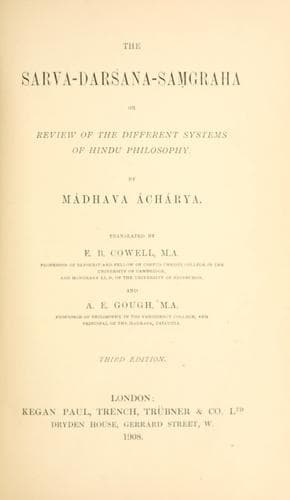
The Sarva-Darsana-Samgraha: Or, Review of the Different Systems of Hindu PhilosophyMadhava
ReligionEastern
The Sarva-Darsana-Samgraha: Or, Review of the Different Systems of Hindu Philosophy
Madhava
Philosophy, Hindu; Philosophy, Indic
If it be asked how then that (illusory duality) is predicated, the
answer is that in reality there is a non-duality, that is in reality,
Vishṇu being better than all else, has no equal and no superior.
Accordingly, the grand revelation:--
"A difference between soul and the Lord, a difference
between the unsentient and the Lord,
"A difference among souls, and a difference of the
unsentient and the soul each from the other.
"Also the difference of unsentient things from one another,
the world with its five divisions.
"This same is real and from all eternity; if it had had a
beginning it would have an end:
"Whereas it does not come to an end; and it is not
illusorily imagined:
"For if it were imagined it would cease, but it never
ceases.
"That there is no duality is therefore the doctrine of those
that lack knowledge;
"For this the doctrine of those that have knowledge is known
and sustained by Vishṇu."
The purpose, then, of all revelations is to set out the supreme
excellence of Vishṇu. With this in view the Lord declared:--
"Two are these persons in the universe, the perishable and
the imperishable;
"The perishable is all the elements, the imperishable is the
unmodified.
"The other, the most excellent person, called the Supreme
Spirit,
"Is the undecaying Lord, who pervading sustains the three
worlds.
"Since transcending the perishable, I am more excellent than
the imperishable (soul),
"Hence I am celebrated among men and in the Veda as the best
of persons (_Purushottama_);
"He who uninfatuated knows me thus the best of persons, he
all-knowing worships me in every wise.
"Thus this most mysterious institute is declared, blameless
(Arjuna):
"Knowing this a man may be wise, and may have done what he
has to do, O Bhárata" (Bhagavad-gítá, xv. 16-20).
So in the Mahá-varáha--
"The primary purport of all the Vedas relates to the supreme
spouse of Śrī;
"Its purport regarding the excellence of any other deity
must be subordinate."
It is reasonable that the primary purport should regard the supreme
excellence of Vishṇu. For emancipation is the highest end of all men,
according to the text of the Bhállaveya Upanishad: While merit,
wealth, and enjoyment are transitory, emancipation is eternal;
therefore a wise man should strive unceasingly to attain thereto. And
emancipation is not won without the grace of Vishṇu, according to the
text of the Náráyaṇa Upanishad: Through whose grace is the highest
state, through whose essence he is liberated from transmigration,
while inferior men propitiating the divinities are not emancipated;
the supreme object of discernment to those who desire to be liberated
from this snare of works. According also to the words of the
Vishṇu-puráṇa--
Public-domain text, read in full here on John Shaqi.
Reviews
Reviews
No reviews yet
Be the first to share your thoughts on this work.
Elsewhere in the archive
Join the Discussion
Join the discussion
Sign in to leave a comment or review.
Sign InorCreate an account