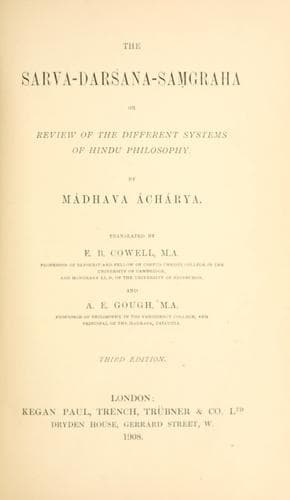
The Sarva-Darsana-Samgraha: Or, Review of the Different Systems of Hindu PhilosophyMadhava
ReligionEastern
The Sarva-Darsana-Samgraha: Or, Review of the Different Systems of Hindu Philosophy
Madhava
Philosophy, Hindu; Philosophy, Indic
"If he be propitiated, what may not here be won? Enough of all wealth
and enjoyments. These are scanty enough. On climbing the tree of the
supreme essence, without doubt a man attains to the fruit of
emancipation."
And it is declared that the grace of Vishṇu is won only through the
knowledge of his excellence, not through the knowledge of non-duality.
Nor is there in this doctrine any confliction with texts declaratory
of the identity (of personal and impersonal spirit) such as, That art
thou (for this pretended identity) is mere babbling from ignorance of
the real purport.
"The word That, when undetermined, designates the eternally
unknown,
"The word Thou designates a knowable entity; how can these
be one?"
And this text (That art thou) indicates similarity (not identity) like
the text, The sun is the sacrificial post. Thus the grand
revelation:--
"The ultimate unity of the individual soul is either
similarity of cognition,
"Or entrance into the same place, or in relation to the
place of the individual;
"Not essential unity, for even when it is emancipated it is
different,
"The difference being independence and completeness (in the
Supreme Spirit), and smallness and dependence (in the
individual spirit)."
Or to propose another explanation of the text, _Átmá tat tvam asi_,
That art thou, it may be divided, _átmá tat tvam asi_. He alone is
soul as possessing independence and other attributes, and thou art
not-that (_atat_) as wanting those attributes; and thus the doctrine
of unity is utterly expelled. Thus it has been said:--
"Or the division may be _Atat tvam_, and thus unity will be
well got rid of."
According, therefore, to the Tattva-váda-rahasya, the words in the
nine examples (in the Chhándogya Upanishad), He like a bird tied with
a string, &c., teach unity with the view of giving an example of
non-duality. Accordingly the Mahopanishad:--
"Like a bird and the string; like the juices of various
trees;
"Like rivers and the sea; like fresh and salt water;
"Like a robber and the robbed; like a man and his energy;
"So are soul and the Lord diverse, for ever different.
"Nevertheless from subtilty (or imperceptibility) of form,
the supreme Hari
"Is not seen by the dim-sighted to be other than the
individual spirit, though he is its actuator;
"On knowing their diversity a man is emancipated: otherwise
he is bound."
And again--
"Brahmá, Śiva, and the greatest of the gods decay with the
decay of their bodies;
"Greater than these is Hari, undecaying, because his body is
for the sustentation of Lakshmí.
"By reason of all his attributes, independence, power,
knowledge, pleasure, and the rest,
"All they, all the deities, are in unlimited obedience to
him."
And again:--
"Knowing Vishṇu, full of all excellences, the soul, exempted
from transmigration,
Public-domain text, read in full here on John Shaqi.
Reviews
Reviews
No reviews yet
Be the first to share your thoughts on this work.
Elsewhere in the archive
Join the Discussion
Join the discussion
Sign in to leave a comment or review.
Sign InorCreate an account