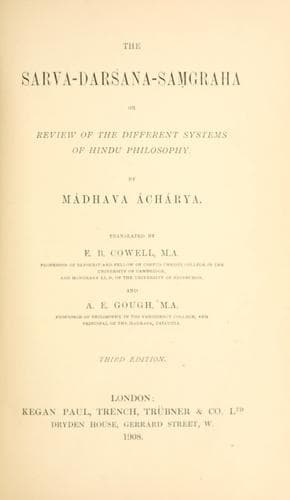
The Sarva-Darsana-Samgraha: Or, Review of the Different Systems of Hindu PhilosophyMadhava
ReligionEastern
The Sarva-Darsana-Samgraha: Or, Review of the Different Systems of Hindu Philosophy
Madhava
Philosophy, Hindu; Philosophy, Indic
"Rejoices in his presence for ever, enjoying painless bliss.
"Vishṇu is the refuge of liberated souls, and their supreme
ruler.
"Obedient to him are they for ever; he is the Lord."
That by knowledge of one thing there is knowledge of all things may be
evinced from its supremacy and causality, not from the falsity of all
things. For knowledge of the false cannot be brought about by
knowledge of real existence. As we see the current assurance and
expression that by knowing or not knowing its chief men a village is
known or not known; and as when the father the cause is known, a man
knows the son; (so by knowing the supreme and the cause, the inferior
and the effect is known). Otherwise (on the doctrine of the
Advaita-vádins that the world is false and illusory) the words _one_
and _lump_ in the text, By one lump of clay, fair sir, all that is
made of clay is recognised, would be used to no purpose, for the text
must be completed by supplying the words, By reason of clay
recognised. For the text, Utterance with the voice, modification,
name, clay (or other determinate object),--these alone are real,
cannot be assumed to impart the falsity of things made; the reality of
these being admitted, for what is meant is, that of which utterance
with the voice is a modification, is unmodified, eternal; and a name
such as clay, such speech is true. Otherwise it would result that the
words _name_ and _alone_ would be otiose. There is no proof anywhere,
then, that the world is unreal. Besides (we would ask) is the
statement that the world is false itself true or false. If the
statement is true, there is a violation of a real non-duality. If the
statement is untrue, it follows that the world is true.
Perhaps it may be objected that this dilemma is a kind of fallacious
reasoning, like the dilemma: Is transitoriness permanent or
transitory? There is a difficulty in either case. As it is said by the
author of the Nyáya-nirváṇa: The proof of the permanence of the
transitory, as being both permanent and transitory, is a paralogism.
And in the Tárkika-rakshá--
"When a mode cannot be evinced to be either such and such,
or not such and such,
"The denial of a subject characterised by such a mode is
called Nitya-sama."
Public-domain text, read in full here on John Shaqi.
Reviews
Reviews
No reviews yet
Be the first to share your thoughts on this work.
Elsewhere in the archive
Join the Discussion
Join the discussion
Sign in to leave a comment or review.
Sign InorCreate an account