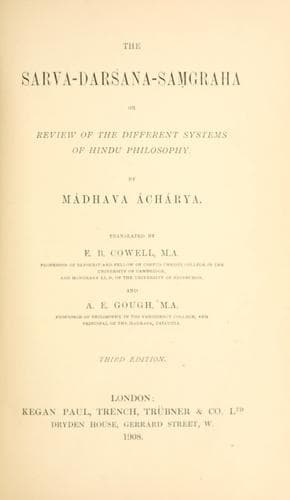
The Sarva-Darsana-Samgraha: Or, Review of the Different Systems of Hindu PhilosophyMadhava
ReligionEastern
The Sarva-Darsana-Samgraha: Or, Review of the Different Systems of Hindu Philosophy
Madhava
Philosophy, Hindu; Philosophy, Indic
With the implied mention of this same technical expression it is
stated in the Prabodha-siddhi: Equality of characteristic modes
results from significancy. If it be said, This then is a valid
rejoinder, we reply, This is a mere scaring of the uninstructed, for
the source of fallacy has not been pointed out. This is twofold,
general and particular: of these, the former is self-destructive, and
the latter is of three kinds, defect of a requisite element, excess of
an element not requisite, and residence in that which is not the
subjicible subject. Of these (two forms of the fallacy), the general
form is not suspected, no self-pervasion being observed in the dilemma
in question (viz., Is the statement that the world is unreal itself
true or false? &c.) So likewise the particular; for if a water-jar be
said to be non-existent, the affirmation of its non-existence is
equally applicable to the water-jar as that of its existence.
If you reply: We accept the unreality (or falsity) of the world, not
its non-existence; this reply is about as wise as the procedure of the
carter who will lose his head rather than pay a hundred pieces of
money, but will at once give five score; for falsity and non-existence
are synonymous. We dismiss further prolixity.
The meaning of the first aphorism, viz., Then hence the absolute is to
be desired to be known, is as follows:--The word _then_ is allowed to
purport auspiciousness, and to designate subsequency to the
qualification (of the aspirant). The word _hence_ indicates a reason.
Accordingly it is stated in the Gáruḍa-puráṇa:--
"All the aphorisms begin with the words Then and Hence
regularly; what then is the reason of this?
"And what is the sense of those words, O sage? Why are those
the most excellent?
"Tell me this, Brahmá, that I may know it truly."
Thus addressed by Nárada, the most excellent Brahmá replied:--
"The word Then is used of subsequency and of competency, and
in an auspicious sense,
"And the word Thence is employed to indicate the reason."
It is laid down that we must institute inquiries about the absolute,
because emancipation is not attained without the grace of Náráyana,
and his grace is not attained without knowledge. The absolute, about
which the inquiry is to be instituted, is described in the words (of
the second aphorism): From which the genesis, and so forth, of this.
The meaning of the sentence is that the absolute is that from which
result emanation, sustentation, and retractation; according to the
words of the Skanda-puráṇa--
"He is Hari the sole ruler, the spirit from whom are
emanation, sustentation, retractation, necessity, knowledge,
involution (in illusion), and bondage and liberation;"
Public-domain text, read in full here on John Shaqi.
Reviews
Reviews
No reviews yet
Be the first to share your thoughts on this work.
Elsewhere in the archive
Join the Discussion
Join the discussion
Sign in to leave a comment or review.
Sign InorCreate an account