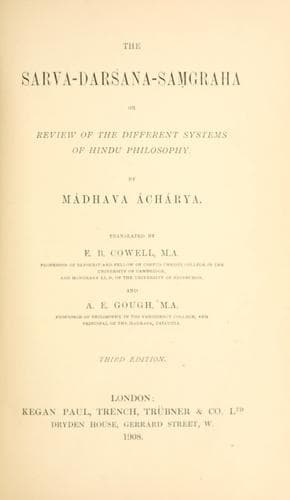
The Sarva-Darsana-Samgraha: Or, Review of the Different Systems of Hindu PhilosophyMadhava
ReligionEastern
The Sarva-Darsana-Samgraha: Or, Review of the Different Systems of Hindu Philosophy
Madhava
Philosophy, Hindu; Philosophy, Indic
and according to such Vedic texts, From which are these. The evidence
adducible for this is described (in the third aphorism): Because it
has its source from the system. That the absolute should be reached by
way of inference is rejected by such texts as, He that knows not the
Veda cogitates not that mighty one; Him described in the Upanishads.
Inference, moreover, is not by itself authoritative, as is said in the
Kaurma-puráṇa--
"Inference, unaccompanied by revelation, in no case
"Can definitely prove a matter, nor can any other form of
evidence;
"Whatsoever other form of evidence, companioned by
revelation and tradition,
"Acquires the rank of probation, about this there can be no
hesitation."
What a Śástra (or system of sacred institutes) is, has been stated in
the Skanda-puráṇa:--
"The Rig-veda, the Yajur-veda, the Sáma-veda, the
Atharva-veda, the Mahábhárata, the Pañcha-rátra, and the
original Rámáyaṇa, are called Śástras.
"That also which is conformable to these is called Śástra.
"Any aggregate of composition other than this is a
heterodoxy."
According, then, to the rule that the sense of the sacred institutes
is not to be taken from other sources than these, the Monist view,
viz., that the purport of the texts of the Veda relates not to the
duality learnt from those but to non-duality, is rejected: for as
there is no proof of a God from inference, so there is no proof of the
duality between God and other things from inference. Therefore there
can be in these texts no mere explanation of such duality, and the
texts must be understood to indicate the duality. Hence it is that it
has said:--
"I ever laud Náráyaṇa, the one being to be known from
genuine revelation, who transcends the perishable and the
imperishable, without imperfections, and of inexhaustible
excellences."
It has thus been evinced that the sacred institutes are the evidence
of (the existence of) this (ultimate reality, _Brahman_). (The fourth
aphorism is): But that is from the construction. In regard to this,
the commencement and other elements are stated to be the marks of the
construction, in the Bṛihat-saṃhitá:--
"Commencement, conclusion, reiteration, novelty, profit,
eulogy, and demonstration, are the marks by which the
purport is ascertained."
It is thus stated that in accordance with the purport of the
Upanishads the absolute is to be apprehended only from the sacred
institutes. We have here given merely a general indication. What
remains may be sought from the Ánandatírtha-bháshya-vyákhyána (or
exposition of the Commentary of Ánanda-tírtha). We desist for fear of
giving an undue prolixity to our treatise. This mystery was
promulgated by Púrṇa-prajña Madhya-mandira, who esteemed himself the
third incarnation of Váyu:--
"The first was Hanumat, the second Bhíma,
"The third Púrṇa-prajña, the worker of the work of the
Lord."
Public-domain text, read in full here on John Shaqi.
Reviews
Reviews
No reviews yet
Be the first to share your thoughts on this work.
Elsewhere in the archive
Join the Discussion
Join the discussion
Sign in to leave a comment or review.
Sign InorCreate an account