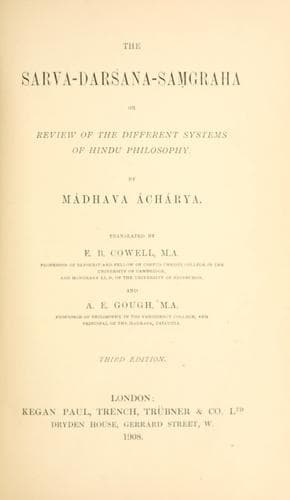
The Sarva-Darsana-Samgraha: Or, Review of the Different Systems of Hindu PhilosophyMadhava
ReligionEastern
The Sarva-Darsana-Samgraha: Or, Review of the Different Systems of Hindu Philosophy
Madhava
Philosophy, Hindu; Philosophy, Indic
After expressing the same idea in various passages, he has written the
following stanza at the conclusion of his work:--
"That whereof the three divine forms are declared in the
text of the Veda, sufficiently
"Has that been set forth; this is the whole majesty in the
splendour of the Veda;
"The first incarnation of the Wind-god was he that bowed to
the words of Ráma (Hanumat); the second was Bhíma;
"By this Madhva, who is the third, this book has been
composed in regard to Keśava."
The import of this stanza may be learnt by considering various Vedic
texts.
The purport of this is that Vishṇu is the principle above all others
in every system of sacred institutes. Thus all is clear.[111]
A. E. G.
FOOTNOTES:
[Footnote 111: For a further account of Ánanda-tírtha or Madhva see
Wilson, Works, vol. i. pp. 138-150. His Commentary on the
Brahma-sútras has been printed in Calcutta.]
CHAPTER VI.
THE PÁŚUPATA SYSTEM OF NAKULÍŚA.
Certain Máheśvaras disapprove of this doctrine of the Vaishṇavas known
by its technicalities of the servitude of souls and the like, inasmuch
as bringing with it the pains of dependence upon another, it cannot be
a means of cessation of pain and other desired ends. They recognise as
stringent such arguments as, Those depending on another and longing
for independence do not become emancipated, because they still depend
upon another, being destitute of independence like ourselves and
others; and, Liberated spirits possess the attributes of the Supreme
Deity, because at the same time, that they are spirits they are free
from the germ of every pain as the Supreme Deity is. Recognising these
arguments, these Máheśvaras adopt the Páśupata system, which is
conversant about the exposition of five categories, as the means to
the highest end of man. In this system the first aphorism is: Now then
we shall expound the Páśupata union and rites of Paśupati. The meaning
is as follows:--The word _now_ refers to something antecedent, and
this something antecedent is the disciple's interrogation of the
spiritual teacher. The nature of a spiritual teacher is explicated in
the Gaṇakáriká:--
"But there are eight pentads to be known, and a group, one
with three factors;
"He that knows this ninefold aggregate is a self-purifier, a
spiritual guide.
"The acquisitions, the impurities, the expedients, the
localities, the perseverance, the purifications,
"The initiations, and the powers, are the eight pentads; and
there are three functions."
The employment in the above line of the neuter numeral three
(_tríṇi_), instead of the feminine three (_tisraḥ_), is a Vedic
construction.
(_a._) Acquisition is the fruit of an expedient while realising, and
is divided into five members, viz., knowledge, penance, permanence of
the body, constancy, and purity. Thus Haradattáchárya says: Knowledge,
penance, permanence, constancy, and purity as the fifth.
Public-domain text, read in full here on John Shaqi.
Reviews
Reviews
No reviews yet
Be the first to share your thoughts on this work.
Elsewhere in the archive
Join the Discussion
Join the discussion
Sign in to leave a comment or review.
Sign InorCreate an account