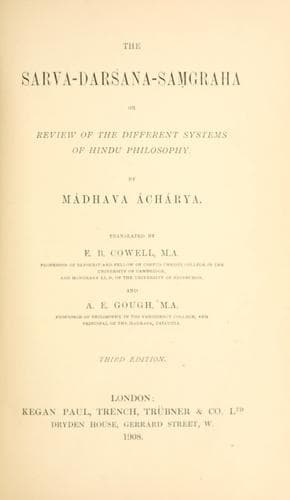
The Sarva-Darsana-Samgraha: Or, Review of the Different Systems of Hindu PhilosophyMadhava
ReligionEastern
The Sarva-Darsana-Samgraha: Or, Review of the Different Systems of Hindu Philosophy
Madhava
Philosophy, Hindu; Philosophy, Indic
Some one may urge: In another system emancipation is attained through
a knowledge of God, where does the difference lie? Say not so, replies
the Páśupata, for you will be caught in a trilemma. Is the mere
knowledge of God the cause of emancipation, or the presentation, or
the accurate characterisation, of God? Not the mere knowledge, for
then it would follow that the study of any system would be
superfluous, inasmuch as without any institutional system one might,
like the uninstructed, attain emancipation by the bare cognition that
Mahádeva is the lord of the gods. Nor is presentation or intuition of
the deity the cause of emancipation, for no intuition of the deity is
competent to sentient creatures burdened with an accumulation of
various impurities, and able to see only with the eyes of the flesh.
On the third alternative, viz., that the cause of emancipation is an
accurate characterisation of the deity, you will be obliged to consent
to our doctrine, inasmuch as such accurate characterisation cannot be
realised apart from the system of the Páśupatas. Therefore it is that
our great teacher has said:--
"If by mere knowledge, it is not according to any system,
but intuition is unattainable;
"There is no accurate characterisation of principles
otherwise than by the five categories."
Therefore those excellent persons who aspire to the highest end of man
must adopt the system of the Páśupatas, which undertakes the
exposition of the five categories.
A. E. G.
CHAPTER VII.
THE ŚAIVA-DARŚANA.
[The seventh system in Mádhava's Sarva-darśana-saṅgraha is the
Śaiva-darśana. This sect is very prevalent in the South of India,
especially in the Tamil country; it is said to have arisen there about
the eleventh century A.D. Several valuable contributions have been
lately made to our knowledge of its tenets in the publications of the
Rev. H. R. Hoisington and the Rev. T. Foulkes. The former especially,
by his excellent articles in the American Oriental Society's Journal,
has performed a great service to the students of Hindu philosophy. He
has there translated the Tattuva-Kaṭṭalei, or law of the Tattwas, the
Śiva-Gnánapotham, or instruction in the knowledge of God, and the
Śiva-Pirakásam, or light of Śiva, and the three works shed immense
light on the outline as given by Mádhava. One great use of the latter
is to enable us to recognise the original Sanskrit names in their
Tamil disguise, no easy matter occasionally, as _aṛul_ for _anugraha_
and _tíḍchei_ for _díkshá_ may testify.
Public-domain text, read in full here on John Shaqi.
Reviews
Reviews
No reviews yet
Be the first to share your thoughts on this work.
Elsewhere in the archive
Join the Discussion
Join the discussion
Sign in to leave a comment or review.
Sign InorCreate an account