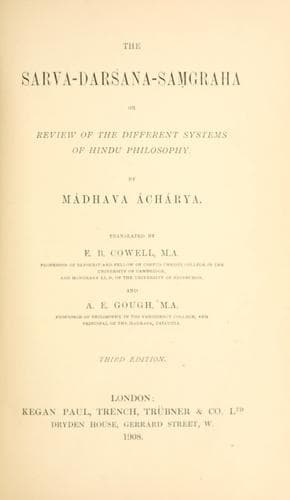
The Sarva-Darsana-Samgraha: Or, Review of the Different Systems of Hindu PhilosophyMadhava
ReligionEastern
The Sarva-Darsana-Samgraha: Or, Review of the Different Systems of Hindu Philosophy
Madhava
Philosophy, Hindu; Philosophy, Indic
The Śaivas have considerable resemblance to the Theistic Sánkhya; they
hold that God, souls, and matter are from eternity distinct entities,
and the object of philosophy is to disunite the soul from matter and
gradually to unite it to God. Śiva is the chief deity of the system,
and the relation between the three is quaintly expressed by the
allegory of a beast, its fetters, and its owner. Paśupati is a
well-known name of Śiva, as the master or creator of all things.
There seem to be three different sets of so-called Saiva sútras. One is in
five books, called by Colebrooke the Paśupati-śástra, which is probably
the work quoted by Mádhava in his account of the Nakulíśa Páśupatas;
another is in three books, with a commentary by Kshemarája, with its first
sútra, _chaítanyam átmá_. The third was commented on by Abhinava-gupta,
and opens with the śloka given in the Sarva-Darśana-Saṅgraha, p. 91, lines
1-4. The MS. which I consulted in Calcutta read the first words--
_Kathañchid ásádya Maheśvarasya dásyam._
None of these works, however, appear to be the authority of the
present sect. They seem chiefly to have relied on the twenty-eight
Ágamas and some of the Puráṇas. A list of the Ágamas is given in Mr.
Foulkes' "Catechism of the Śaiva Religion;" and of these the Kiraṇa
and Karaṇa are quoted in the following treatise.]
THE ŚAIVA-DARŚANA.
Certain, however, of the Máheśvara sect receiving the system of truth
authoritatively laid down in the Śaiva Ágama,[112] reject the
foregoing opinion that "the Supreme Being is a cause as independent of
our actions, &c.," on the ground of its being liable to the imputation
of partiality and cruelty. They, on the contrary, hold the opinion
that "the Supreme Being is a cause in dependence on our actions, &c.;"
and they maintain that there are three categories distinguished as the
Lord, the soul, and the world (or literally "the master," "the
cattle," and "the fetter"). As has been said by those well versed in
the Tantra doctrines--
"The Guru of the world, having first condensed in one sútra
the great tantra, possessed of three categories and four
feet, has again declared the same at full length."
Public-domain text, read in full here on John Shaqi.
Reviews
Reviews
No reviews yet
Be the first to share your thoughts on this work.
Elsewhere in the archive
Join the Discussion
Join the discussion
Sign in to leave a comment or review.
Sign InorCreate an account