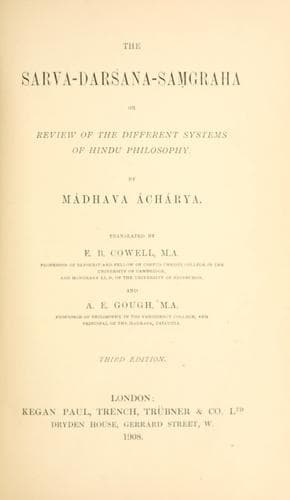
The Sarva-Darsana-Samgraha: Or, Review of the Different Systems of Hindu PhilosophyMadhava
ReligionEastern
The Sarva-Darsana-Samgraha: Or, Review of the Different Systems of Hindu Philosophy
Madhava
Philosophy, Hindu; Philosophy, Indic
The meaning of this is as follows:--Its three categories are the three
before mentioned; its four feet are learning, ceremonial action,
meditation, and morality, hence it is called the great Tantra,
possessed of three categories and four feet. Now the "souls" are not
independent, and the "fetters" are unintelligent, hence the Lord, as
being different from these, is first declared; next follows the
account of the souls as they agree with him in possessing
intelligence; lastly follow the "fetters" or matter, such is the order
of the arrangement.[113] Since the ceremony of initiation is the means
to the highest human end, and this cannot be accomplished without
knowledge which establishes the undoubted greatness of the hymns, the
Lords of the hymns, &c., and is a means for the ascertainment of the
real nature of the "cattle," the "fetter," and the "master," we place
as first the "foot" of _knowledge_ (_jñána_) which makes known all
this unto us.[114] Next follows the "foot" of _ceremonial action_
(_kriyá_) which declares the various rules of initiation with the
divers component parts thereof. Without meditation the end cannot be
attained, hence the "foot" of _meditation_ (_yoga_) follows next,
which declares the various kinds of _yoga_ with their several parts.
And as meditation is worthless without practice, _i.e._, the
fulfilling what is enjoined and the abstaining from what is
forbidden, lastly follows the fourth "foot" of practical duty
(_charyá_), which includes all this.
Now Śiva is held to be the Lord (or master). Although participation in
the divine nature of Śiva belongs to liberated souls and to such
beings as Vidyeśvara, &c., yet these are not independent, since they
depend on the Supreme Being; and the nature of an effect is recognised
to belong to the worlds, &c., which resemble him, from the very fact
of the orderly arrangement of their parts. And from their thus being
effects we infer that they must have been caused by an intelligent
being. By the strength of this inference is the universal
acknowledgment of a Supreme Being confirmed.
Public-domain text, read in full here on John Shaqi.
Reviews
Reviews
No reviews yet
Be the first to share your thoughts on this work.
Elsewhere in the archive
Join the Discussion
Join the discussion
Sign in to leave a comment or review.
Sign InorCreate an account