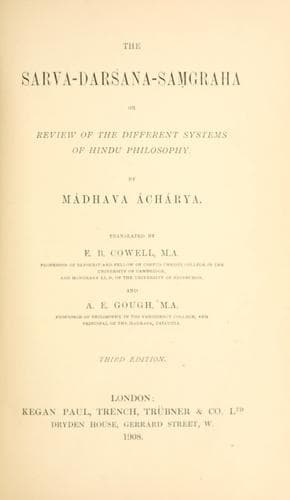
The Sarva-Darsana-Samgraha: Or, Review of the Different Systems of Hindu PhilosophyMadhava
ReligionEastern
The Sarva-Darsana-Samgraha: Or, Review of the Different Systems of Hindu Philosophy
Madhava
Philosophy, Hindu; Philosophy, Indic
"But may we not object that it is not proved that the body is thus an
effect? for certainly none has ever, at any time or place, seen a body
being made by any one." We grant it: yet it is not proper to deny that
a body has some maker on the ground that its being made has not been
seen by any one, since this can be established from inference [if not
from actual perception]. Bodies, &c., must be effects, because they
possess an orderly arrangement of parts, or because they are
destructible, as jars, &c.; and from their being effects it is easy to
infer that they must have been caused by an intelligent being. Thus
the subject in the argument [sc. bodies, &c.] must have had a maker,
from the fact that it is an effect, like jars, &c.; that which has the
afore-mentioned middle term (_sádhana_) must have the afore-mentioned
major (_sádhya_); and that which has not the former will not have the
latter, as the soul, &c.[115] The argument which establishes the
authority of the original inference to prove a Supreme Being has been
given elsewhere, so we refrain from giving it at length here. In fact,
that God is the universal agent, but not irrespective of the actions
done by living beings, is proved by the current verse[116]--
"This ignorant _jívátman_, incapable of its own true
pleasures or pains, if it were only under God's direction
[and its own merits not taken into account], would always go
to heaven or always to hell."[117]
Nor can you object that this opinion violates God's independence,
since it does not really violate an agent's independence to allow that
he does not act irrespectively of means; just as we say that the
king's bounty shows itself in gifts, but these are not irrespective of
his treasurer. As has been said by the Siddha Guru--
"It belongs to independence to be uncontrolled and itself to
employ means, &c.;
"This is an agent's true independence, and not the acting
irrespectively of works, &c."
And thus we conclude that inference (as well as Śruti) establishes the
existence of an agent who knows the various fruits [of action], their
means, material causes, &c., according to the laws of the various
individual merits. This has been thus declared by the venerable
Bṛihaspati--
"He who knows the fruits to be enjoyed, their means and
material causes,--
"Apart from him this world knows not how the desert that
resides in accumulated actions should ripen."--
"The universe is the subject of our argument, and it must
have had an intelligent maker,
"This we maintain from its being an effect, just as we see
in any other effect, as jars, &c."
God's omniscience also is proved from his being identical with
everything, and also from the fact that an ignorant being cannot
produce a thing.[118] This has been said by the illustrious
Mṛigendra[119]--
"He is omniscient from his being the maker of all things:
for it is an established principle
Public-domain text, read in full here on John Shaqi.
Reviews
Reviews
No reviews yet
Be the first to share your thoughts on this work.
Elsewhere in the archive
Join the Discussion
Join the discussion
Sign in to leave a comment or review.
Sign InorCreate an account