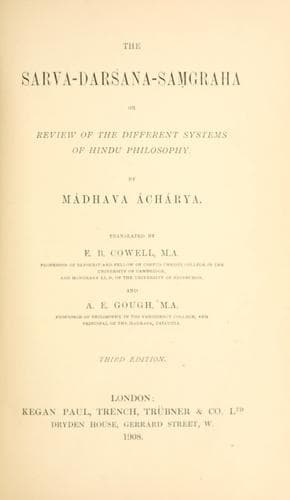
The Sarva-Darsana-Samgraha: Or, Review of the Different Systems of Hindu PhilosophyMadhava
ReligionEastern
The Sarva-Darsana-Samgraha: Or, Review of the Different Systems of Hindu Philosophy
Madhava
Philosophy, Hindu; Philosophy, Indic
"That he only can make a thing who knows it with its means,
parts, and end."
"Well," our opponents may say, "we concede that God is an independent
maker, but then he has no body.[120] Now experience shows that all
effects, as jars, &c., are produced by beings possessed of bodies, as
potters, &c.; but if God were possessed of a body, then he would be
like us subject to trouble, and no longer be omniscient or
omnipotent." We, however, deny this, for we see that the incorporeal
soul does still produce motion, &c., in its associated body; moreover,
even though we conceded that God _did_ possess a body, we should still
maintain that the alleged defects would not necessarily ensue. The
Supreme Being, as he has no possible connection with the fetters of
matter, such as _mala_,[121] action, &c., cannot have a material body,
but only a body of pure energy (Sákta),[122] since we know that his
body is composed of the five hymns which are forms of Śakti, according
to the well-known text: "The Supreme has the _Iśána_ as his head, the
_Tatpurusha_ as his mouth, the _Aghora_ as his heart, the _Vámedeva_
as his secret parts, and the _Sadyojáta_ as his feet."[123] And this
body, created according to his own will, is not like our bodies, but
is the cause of the five operations of the Supreme, which are
respectively grace, obscuration, destruction, preservation, and
production.[124] This has been said in the Śrímat Mṛigendra--
"From the impossibility of its possessing _mala_, &c., the
body of the Supreme is of pure energy, and not like ours."
And it has also been said elsewhere--
"His body is composed of the five mantras which are
subservient to the five operations,
"And his head, &c., are formed out of the Ísa, Tatpurusha,
Aghora, Váma, and other hymns."
If you object to this view that "such passages in the Ágamas as 'He is
five-faced and fifteen-eyed,' assert prominently the fact that the
Supreme Being is endowed with a body, organs, &c.," we concede what
you say, but we maintain that there is no contradiction in his
assuming such forms to show his mercy to his devoted servants, since
meditation, worship, &c., are impossible towards a Being entirely
destitute of form. This has been said in the Paushkara--
"This form of his is mentioned for the preservation of the
devotee."
And similarly elsewhere--
"Thou art to be worshipped according to rule as possessed of
form;
"For the understanding cannot reach to a formless object."
Bhojarája[125] has thus detailed the five operations--
"Fivefold are his operations, creation, preservation,
destruction, and obscuration,
"And to these must be added the active grace of him who is
eternally exalted."
Now these five operations, in the view of the pure Path, are held to
be performed directly by Śiva, but in that of the toilsome Path they
are ascribed to Ananta,[126] as is declared in the Śrímat
Karaṇa[127]--
Public-domain text, read in full here on John Shaqi.
Reviews
Reviews
No reviews yet
Be the first to share your thoughts on this work.
Elsewhere in the archive
Join the Discussion
Join the discussion
Sign in to leave a comment or review.
Sign InorCreate an account