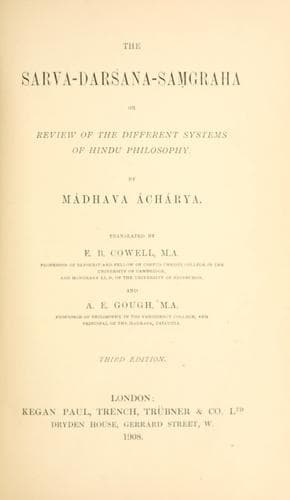
The Sarva-Darsana-Samgraha: Or, Review of the Different Systems of Hindu PhilosophyMadhava
ReligionEastern
The Sarva-Darsana-Samgraha: Or, Review of the Different Systems of Hindu Philosophy
Madhava
Philosophy, Hindu; Philosophy, Indic
"In the Pure Path Śiva is declared to be the only agent, but
Ananta in that which is opposed to the One Supreme."
It must here be understood that the word Śiva includes in its proper
meaning "the Lord," all those who have attained to the state of Śiva,
as the Lords of the Mantras, Maheśwara, the emancipated souls who have
become Śivas, and the inspired teachers (_váchakas_), together with
all the various means, as initiation, &c., for obtaining the state of
Śiva. Thus has been explained the first category, the Lord (_pati_).
We now proceed to explain the second category, the soul (_paśu_). The
individual soul which is also known by such synonyms as the
non-atomic,[128] the _Kshetrajña_, or knower of the body,[129] &c., is
the _Paśu_. For we must not say with the Chárvákas that it is the same
as the body, since on this view we could not account for memory, as
there is a proverb that one man cannot remember what another has seen.
Nor may we say with the Naiyáyikas that it is cognisable by
perception,[130] as this would involve an _ad infinitum_ regressus. As
has been said--
"If the soul were cognisable, there would need to be again a
second knower;[131]
"And this would require another still, if the second were
itself to be known."
Nor must we hold it non-pervading with the Jainas, nor momentary with
the Bauddhas, since it is not limited by space or time. As has been
said--
"That object which is unlimited in its nature by space or
time,
"They hold to be eternal and pervading,--hence the soul's
all-pervadingness and eternity."
Nor may we say with the Vedántin that it is only one, since the
apportionment of different fruits proves that there are many
individual souls; nor with the Sánkhyas that it is devoid of action,
since, when all the various "fetters" are removed, Śruti informs us of
a state of identity with Śiva, which consists in intelligence in the
form of an eternal and infinite vision and action.[132] This has been
declared in the Śrímat Mṛigendra--
"It is revealed that identity with Śiva results when all
fetters are removed."
And again--
"Intelligence consists in vision and action, and since in
his soul
"This exists always and on every side, therefore, after
liberation, Śruti calls it that which faces every way."
It is also said in the Tattva-prakáśa--
"The liberated souls are themselves Śivas, but these are
liberated by his favour;
"He is to be known as the one eternally liberated, whose
body is the five Mantras."
Public-domain text, read in full here on John Shaqi.
Reviews
Reviews
No reviews yet
Be the first to share your thoughts on this work.
Elsewhere in the archive
Join the Discussion
Join the discussion
Sign in to leave a comment or review.
Sign InorCreate an account