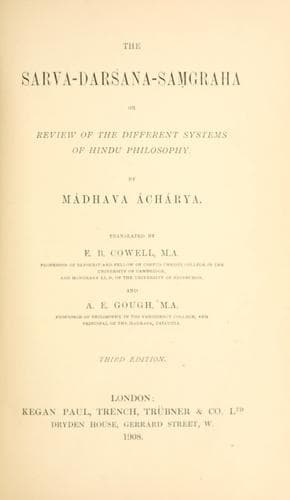
The Sarva-Darsana-Samgraha: Or, Review of the Different Systems of Hindu PhilosophyMadhava
ReligionEastern
The Sarva-Darsana-Samgraha: Or, Review of the Different Systems of Hindu Philosophy
Madhava
Philosophy, Hindu; Philosophy, Indic
Now the souls are threefold, as denominated _vijñánákaláḥ_,
_pralayákaláḥ_, and _sakaláḥ_.[133] (_a._) The first are those who are
under the influence of _mala_ only, since their actions are cancelled by
receiving their proper fruits, or by abstraction, contemplation, and
knowledge, and since they have no "fetters" in the form of enjoyments,
such as _kalá_, &c. (which fetters would, however, be the cause of
cancelling actions by bringing about their proper fruit). (_b._) The
second are those who are under the influence of _mala_ and _karman_, since
in their case _kalá_, &c., are destroyed by mundane destructions, hence
their name _pralayákala_. (_c._) The third are those who are bound in the
three fetters of _mala_, _máyá_, and _karman_, hence their name _sakala_.
The first class are again subdivided into _samápta-kalusháḥ_ and
_asamápta-kalusháḥ_, according as their inherent corruption is perfectly
exhausted or not. The former,--having received the mature penalties of
their corruptions,--are now, as foremost of men and worthy of the
privilege, raised by Śiva's favour to the rank of the Lords of Knowledge
(the Vidyeśvaras), Ananta, and the rest. This ogdoad of the Lords of
Knowledge is described in the Bahudaivatya--
"Ananta, and Súkshma, and Śivottama,
"Ekanetra, and again Ekarudra and Trimúrttika,
"Śríkaṇṭha and Śikhaṇḍin,--these are declared to be the
Vidyeśvaras."
The latter Śiva, in his mercy, raises to the rank of the seventy million
Mantras.[134] All this is explained in the Tattva-prakáśa.[135] Similarly
Soma-Śambhu has said--
"One class is named _vijñánákala_, the second _pralayákala_,
"The third _sakala_,--these are the three whom the Śástra
regards as objects of mercy.
"The first is united to _mala_ alone, the second to _mala_
and _karma_,
"The third are united to all the tattvas beginning with
_kalá_ and ending with 'earth.'"[136]
The _Pralayákaláḥ_ are also twofold, as being _pakvapáśadvaya_ or not,
_i.e._, those in whom the two remaining fetters are matured, and those in
whom they are not. The former attain liberation, but the latter, by the
power of _karman_, are endowed with the _puryashṭaka_[137] body, and pass
through various births. As has been said in the Tattva-prakáśa--
"Those among the Pralayákalas whose _karman_ and _mala_ are
immature,
"Go, united with the _puryashṭaka_ body, into many births by
the power of _karman_."
The _puryashṭaka_ is also thus described in the same work--
"The _puryashṭaka_ is composed of the internal organ,
thought (_dhí_), _karman_, and the instruments."
This is thus explained by Aghora Śiva Áchárya, "the _puryashṭaka_ is a
subtile body apportioned to each individual soul, which continues from
the creation until the close of the kalpa, or until liberation: it is
composed of the thirty[138] tattvas beginning with 'earth' and ending
with _kalá_." As has been said in the Tattva-sangraha--
Public-domain text, read in full here on John Shaqi.
Reviews
Reviews
No reviews yet
Be the first to share your thoughts on this work.
Elsewhere in the archive
Join the Discussion
Join the discussion
Sign in to leave a comment or review.
Sign InorCreate an account