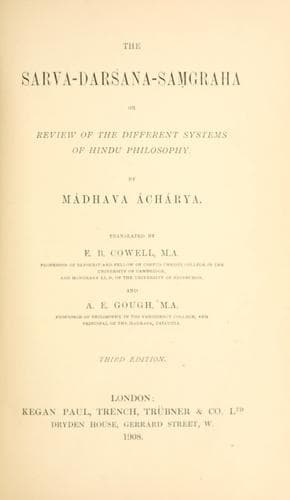
The Sarva-Darsana-Samgraha: Or, Review of the Different Systems of Hindu PhilosophyMadhava
ReligionEastern
The Sarva-Darsana-Samgraha: Or, Review of the Different Systems of Hindu Philosophy
Madhava
Philosophy, Hindu; Philosophy, Indic
"This set of tattvas, commencing with 'earth' and ending
with _kalá_, is assigned to each soul,
"And wanders by the law of _karman_ through all the bodies
produced by the world."
The following is the full meaning of this passage:--The word
"_internal organ_," which properly includes "mind," "intelligence,"
"egoism," and "reason,"[139] includes also the seven tattvas which
enter into the production of enjoyment [or experience], viz., those
called _kalá_, time, fate, knowledge, concupiscence, nature, and
quality;[140] the words "_thought_" (_dhí_) and _karman_ signify the
five cognisable gross elements, and their originators, the subtile
rudiments. By the word "_instruments_" are comprehended the ten organs
of sense and action.
"But is it not declared in the Śrímat Kálottara that 'The set of five,
sound, touch, form, taste and smell, intelligence, mind and egoism,
these constitute the _puryashṭaka_?'"
How, then, can any different account be maintained? We grant this, and
hence the venerable Ráma Kaṇṭha has explained that sútra in its
literal meaning [_i. e_., as _puryashṭaka_, is derived from _ashṭa_,
"eight"], so why should we be prolix in the discussion? Still, if you
ask how we can reconcile our account with the strict nominal
definition of _puryashṭaka_, we reply that there is really no
contradiction, as we maintain that it is composed of a set of eight in
the following manner:--(1.) The five elements; (2.) the five
rudiments; (3.) the five organs of knowledge; (4.) those of action;
(5.) the fourfold internal organ; (6.) their instrument;[141] (7.)
nature [prakṛiti]; and (8.) the class composed of the five, beginning
with _kalá_, which form a kind of case.[142]
Now in the case of some of those souls who are joined to the
_puryashṭaka_ body, Maheśvara Ananta having compassionated them as
possessed of peculiar merit, constitutes them here as lords of the
world; as has been said--
"Maheśvara pities some and grants them to be lords of the
world."
The class called _sakala_ is also divided into two, as _pakvakalusha_
and _apakvakalusha_. As for the former, the Supreme Being, in
conformity with their maturity (_paripáka_), puts forth a power
agreeable thereto, and transfers them to the position of the hundred
and eighteen Lords of the Mantras, signified by the words Maṇḍalí,
&c., as has been said--
"The rest are denominated _sakala_, from their connection
with _Kalá_, &c., seized by time whose mouths are days;
"The Supreme of his own will makes one hundred and eighteen
of these the Lords of the Mantras.
"Eight of these are called _Maṇḍalins_; eight again are
Krodha, &c.;
"Víreśa, Śríkaṇṭha, and the hundred Rudras,--these together
are the hundred and eighteen."
Public-domain text, read in full here on John Shaqi.
Reviews
Reviews
No reviews yet
Be the first to share your thoughts on this work.
Elsewhere in the archive
Join the Discussion
Join the discussion
Sign in to leave a comment or review.
Sign InorCreate an account