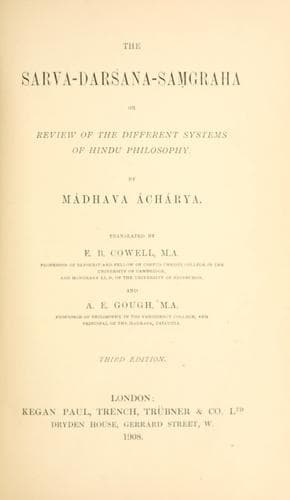
The Sarva-Darsana-Samgraha: Or, Review of the Different Systems of Hindu PhilosophyMadhava
ReligionEastern
The Sarva-Darsana-Samgraha: Or, Review of the Different Systems of Hindu Philosophy
Madhava
Philosophy, Hindu; Philosophy, Indic
In their case again, the Supreme, having assumed the form of a
teacher, stops the continued accession of maturity and contracts his
manifested power, and ultimately grants to them liberation by the
process of initiation; as has been said--
"These creatures whose _mala_ is matured, by putting forth a
healing power,
"He, assuming the form of a teacher, unites by initiation to
the highest principle."
It is also said in the Srímad Mṛigendra--
"He removes from that infinitesimal soul all the bonds which
previously exerted a contrary influence over it."[143]
All this has been explained at great length by Náráyaṇa-Kaṇṭha, and
there it is to be studied; but we are obliged to pass on through fear
of prolixity.
But as for the second class, or those called _apakvakalusha_, the
Supreme Being, as impelled by the desert of their respective actions,
appoints them, as bound and endued with infinitesimal bodies, to enjoy
the rewards of their previous actions.[144] As has been said--
"The other souls, bound [in their material bonds] he
appoints to enjoy their various deserts,
"According to their respective actions: such are the various
kinds of souls."
We now proceed to describe the third category, matter (or _páśa_).
This is fourfold, _mala_,[1] _karman_, _máyá_, and _rodha-śakti_.[145]
But it may be objected, "Is it not said in the Śaiva Ágamas that the
chief things are the Lord, souls, and matter? Now the Lord has been
shown to mean Śiva, 'souls' mean atoms (or beings endowed with atomic
bodies), and matter (or 'bond') is said to be the pentad,[146] hence
matter will be fivefold. How then is it now reckoned to be only
fourfold?" To this we reply as follows:--Although the _vindu_ or nasal
dot, which is the germinal atom of _máyá_, and is called a
Śiva-tattva, may be well regarded as material in comparison with the
highest liberation as defined by the attainment of the state of Śiva,
still it cannot really be considered as matter when we remember that
it is a secondary kind of liberation as causing the attainment of the
state of such deities as Vidyeśvara, &c. Thus we see there is no
contradiction. Hence it has been said in the Tattva-prakáśa--
"The bonds of matter will be fourfold."
And again in the Srímad Mṛigendra--
"The enveloper-controller (_mala_), the overpowerer
(_rodha_), action, and the work of Máyá,
"These are the four 'bonds,' and they are collectively
called by the name of 'merit.'"
The following is the meaning of this couplet:--
(1.) "Enveloping," because _mala_ exceedingly obscures and veils the
soul's powers of vision and action; "controlling," because _mala_, a
natural impurity, controls the soul by its independent influence. As
has been said--
"_Mala_, though itself one, by manifold influence interrupts
the soul's vision and action;
"It is to be regarded as the husk in rice or rust on
copper."[147]
Public-domain text, read in full here on John Shaqi.
Reviews
Reviews
No reviews yet
Be the first to share your thoughts on this work.
Elsewhere in the archive
Join the Discussion
Join the discussion
Sign in to leave a comment or review.
Sign InorCreate an account