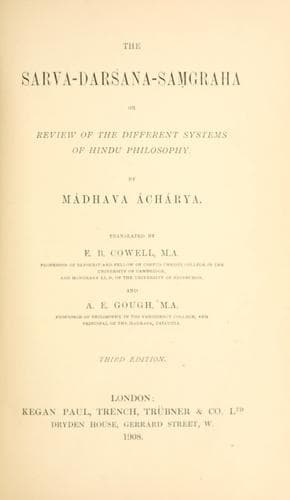
The Sarva-Darsana-Samgraha: Or, Review of the Different Systems of Hindu PhilosophyMadhava
ReligionEastern
The Sarva-Darsana-Samgraha: Or, Review of the Different Systems of Hindu Philosophy
Madhava
Philosophy, Hindu; Philosophy, Indic
(2.) The "overpowerer" is the obscuring power; this is called a "bond"
[or matter] in a metaphorical sense, since this energy of Śiva
obscures the soul by superintending matter [rather than by itself
partaking of the nature of matter].
Thus it has been said--
"Of these I am the chief energy, and the gracious friend of
all,
"I am metaphorically called _páśa_,[148] because I follow
desert."
(3.) Action [or rather its consequences, _karman_] as being performed
by those who desire the fruit. It is in the form of merit or demerit,
like the seed and shoot, and it is eternal in a never-beginning
series. As has been said in the Śrímat Kiraṇa--
"As _Mala_ has no beginning, its least actions are
beginningless:
"If an eternal character is thus established, then what
cause could produce any change therein?"
(4.) "_Máyá_," because herein as an energy of the Divine Being all
the world is potentially contained (_máti_) at a mundane destruction,
and again at a creation it all comes (_yáti_) into manifestation,
hence the derivation of the name. This has been said in the Śrímat
Saurabheya--
"The effects, as a form of the Divine energy, are absorbed
therein at a mundane destruction,
"And again at a renovation it is manifested anew in the form
of effects as _kalá_, &c."[149]
Although much more might be added on this topic, yet we stop here
through fear of extending this treatise too far. Thus have the three
categories been declared,--the Lord, the soul, and matter.
A different mode of treating the subject is found in the
Jñánaratnávalí, &c., in such lines as--
"The Lord, knowledge, ignorance, the soul, matter, and the
cause
"Of the cessation thereof,--these are collectively the six
categories."
But our readers must seek for full information from the work itself.
Thus our account of the system is complete.
E. B. C.
FOOTNOTES:
[Footnote 112: Colebrooke speaks of the _Paśupati-sástra_
(_Maheśvara-siddhánta or Sivágama_), as the text-book of the Páśupata
sect. The Ágamas are said to be twenty-eight (see their names in the
Rev. T. Foulkes' "Catechism of the Śaiva Religion").]
[Footnote 113: "There must be three eternal entities, Deity, soul,
matter;" "as the water is co-eternal with the sea and the salt with
the water, so soul is co-eternal with the Deity, and _páśa_ is
eternally co-existent with soul" (J. A. O. S. iv. pp. 67, 85). In p.
58 we find the _advaita_ of the Vedánta attacked. In p. 62 it is said
that the soul is eternally entangled in matter, and God carries on his
five operations (see _infra_) to disentangle it, bringing out all that
is required for previous desert.]
Public-domain text, read in full here on John Shaqi.
Reviews
Reviews
No reviews yet
Be the first to share your thoughts on this work.
Elsewhere in the archive
Join the Discussion
Join the discussion
Sign in to leave a comment or review.
Sign InorCreate an account