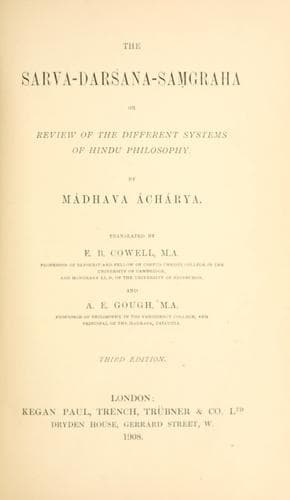
The Sarva-Darsana-Samgraha: Or, Review of the Different Systems of Hindu PhilosophyMadhava
ReligionEastern
The Sarva-Darsana-Samgraha: Or, Review of the Different Systems of Hindu Philosophy
Madhava
Philosophy, Hindu; Philosophy, Indic
[Footnote 114: These four feet are the four stages of religious life
(see J. A. O. S. iv. pp. 135, 180), called in Tamil _sarithei_,
_kirikei_, _yokam_, and _gnánam_. The first is the stage of practical
piety and performance of the prescribed duties and rites; the second
is that of the "confirmatory sacrament" and the five purifications
involved in true _pújá_; the third is that of the eight observances of
the yogin; the fourth is that of knowledge which prepares the soul for
intimate union with God.]
[Footnote 115: Cf. Colebrooke, _Essays_ (2d ed.), vol. i. p. 315.]
[Footnote 116: _Nyáyena_ may here mean "argument."]
[Footnote 117: _Scil._ if there were only one cause there would be
only one invariable effect. The very existence of various effects
proves that there must be other concurrent causes (as human actions)
necessary. The argument seems to me to require here this unnatural
stress to be laid on _eva_, but this is certainly not the original
meaning of the passage; it occurs Mahábhárata, iii. 1144 (cf.
Gauḍapáda, S. Kár. 61).]
[Footnote 118: In p. 82, line 3, _infra_, I read
_Karaṇásambhaváchcha_.]
[Footnote 119: This may be the same with the Meykáṇḍa of the Tamil
work in J. A. O. S. His poem was called the _Mṛigendra_(?).]
[Footnote 120: Should we read _távad anaśaríraḥ_ in p. 83, line 2?]
[Footnote 121: I retain this word, see _infra._]
[Footnote 122: "_Máyá_ (or Prakṛiti) is the material, Śakti the
instrumental, and Deity the efficient cause" (J. A. O. S. iv. p. 55).]
[Footnote 123: These are the five first names of the eleven mantras
which are included in the five _kalás_ (J. A. O. S. iv. pp. 238-243).
The Śivalinga (the visible object of worship for the enlightened) is
composed of mantras, and is to be regarded as the body of Śiva (see J.
A. O. S. iv. p. 101). These five mantras are given in the inverse
order in Taitt. Áraṇyaka, x. 43-47 (cf. _Nyáyá-málávist._ p. 3).]
[Footnote 124: These are the operations of the five manifestations of
Śiva (see J. A. O. S. iv. 8, 18) which in their descending order are
_Sáthákkiyam_ (_i.e._, _Sadákshaya?_) or _Sadá-Śiva_, who is Śiva and
Śakti combined, and the source of grace to all souls; _Ichchuran_ or
_Mayesuran_, the obscure; _Sutta-vittei_ (_Śuddhavidyá_) which is
properly the Hindu triad, _Rudra_, _Vishṇu_, and _Brahma_. They are
respectively symbolised by the _náda_, _vindu_, _m_, _u_, and _a_ of
Om.]
[Footnote 125: In Wilson's Mackenzie Cat. i. p. 138, we find a Tántrik
work, the _Narapati-jaya-charyá_, ascribed to Bhoja the king of Dhár.]
[Footnote 126: Ananta is a name of Śiva in the Atharva-śiras Upanishad
(see Indische Stud. i. 385).]
[Footnote 127: This is the fourth of the twenty-eight Ágamas (see
Foulkes' Catechism).]
[Footnote 128: _Aṇu?_ "The soul, when clothed with these primary
things (desire, knowledge, action, &c.), is an exceedingly small body"
(Foulkes). Anaṇu is used as an epithet of Brahman in Bṛihad Ar. Up.
iii. 8. 8.]
Public-domain text, read in full here on John Shaqi.
Reviews
Reviews
No reviews yet
Be the first to share your thoughts on this work.
Elsewhere in the archive
Join the Discussion
Join the discussion
Sign in to leave a comment or review.
Sign InorCreate an account