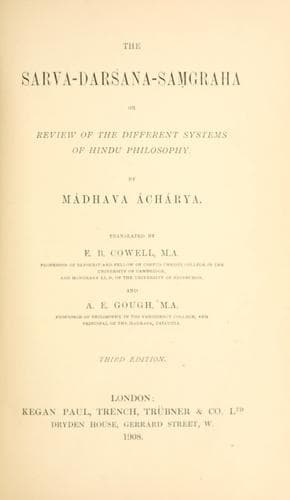
The Sarva-Darsana-Samgraha: Or, Review of the Different Systems of Hindu PhilosophyMadhava
ReligionEastern
The Sarva-Darsana-Samgraha: Or, Review of the Different Systems of Hindu Philosophy
Madhava
Philosophy, Hindu; Philosophy, Indic
[Footnote 129: See Ind. Studien, i. 301.]
[Footnote 130: The mind or internal sense perceives soul (see Bháshá
Parichchheda, śloka 49).]
[Footnote 131: Delete the _iti_ in p. 84, line 5, _infra_.]
[Footnote 132: Cf. the Nakulíśa Páśupatas, p. 76, 4 (_supra_, p.
103).]
[Footnote 133: For these three classes see J. A. O. S. iv. pp. 87,
137. They are there described as being respectively under the
influence of _áṇavam malam_ only, or this with _kanmam malam_, or
these with _mayei malam_. The _áṇavam_ is described as original sin,
or that source of evil which was always attached to the soul; _kanmam_
is that fate which inheres in the soul's organism and metes out its
deserts; _mayei_ is matter in its obscuring or entangling power, the
source of the senses. Mádhava uses "_kalá_," &c., for _máyá_. The
reason is to be found in J. A. O. S. p. 70, where it is said that the
five _vidyátattvas_ (_kalá_, _vidyá_, _rága_, _niyati_, and _kalá_)
and the twenty-four _átmatattvas_ (_sc._ the gross and subtile
elements, and organs of sense and action, with the intellectual
faculties _manas_, _buddhi_, _ahaṃkára_, and _chitta_), are all
developed from _máyá_. This exactly agrees with the quotation from
Soma Śambhu, _infra_. We may compare with it what Mádhava says, p. 77,
in his account of the Nakulíśa Páśupatas, where he describes _kalá_ as
unintelligent, and composed of the five elements, the five
_tanmátras_, and the ten organs, with _buddhi_, _ahaṃkára_ and
_manas_.]
[Footnote 134: See J. A. O. S. iv. p. 137. I read _anugrahakaraṇát_ in
p. 86, line 3.]
[Footnote 135: I omit the quotation, as it only repeats the preceding.
It, however, names the three classes as _vijñána-kevala_,
_pralaya-kevala_, and _sakala_.]
[Footnote 136: _I.e._, thus including five of the _vidyátattvas_ and
all the twenty-four _átmatattvas_.]
[Footnote 137: This term seems to be derived from _purí_, "body" (cf.
_puriśaya_ for _purusha_, Bṛihad Ár. Up. ii. 5, 18), and _ashṭaka_
(cf. also the Sánkhya Pravachana Bháshya, p. 135).]
[Footnote 138: Or rather thirty-one?]
[Footnote 139: _Manas_, _buddhi_, _ahaṃkára_, _chitta_.]
[Footnote 140: These are the seven _viḍyá-tattvas_, _kalá_, _kála_,
_niyati_ (fate), _vidyá_, _rága_, _prakṛiti_, and _guṇa_. Hoisington,
however, puts _purushan_ "the principle of life," instead of _guṇa_,
which seems better, as the three _guṇas_ are included in _prakṛiti_.
He translates _kalá_ by "continency," and describes it as "the power
by which the senses are subdued and the carnal self brought into
subjection."]
[Footnote 141: This "instrument" (_karaṇa_) seems to mean what
Hoisington calls _purushan_ or "the principle of life which
establishes or supports the whole system in its operation;" he makes
it one of the seven _vidyátattvas_. According to Mádhava, it should be
what he calls _guṇa_.]
Public-domain text, read in full here on John Shaqi.
Reviews
Reviews
No reviews yet
Be the first to share your thoughts on this work.
Elsewhere in the archive
Join the Discussion
Join the discussion
Sign in to leave a comment or review.
Sign InorCreate an account