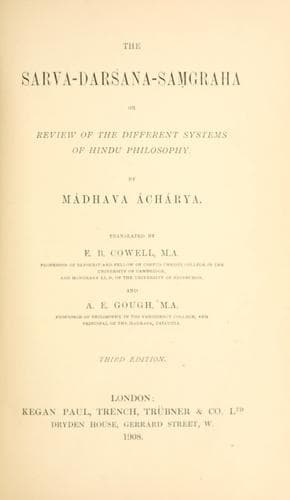
The Sarva-Darsana-Samgraha: Or, Review of the Different Systems of Hindu PhilosophyMadhava
ReligionEastern
The Sarva-Darsana-Samgraha: Or, Review of the Different Systems of Hindu Philosophy
Madhava
Philosophy, Hindu; Philosophy, Indic
[Footnote 142: The thirty-one _tattvas_ are as follow:--Twenty-four
_átmatattvas_, five elements, five _tanmátras_, ten organs of sense
and action, four organs of the _antaḥkaraṇa_, and seven _vidyátattvas_
as enumerated above. (See J. A. O. S. iv. pp. 16-17.)]
[Footnote 143: I take _aṇu_ in this verse as the soul, but it may mean
the second kind of _mala_ mentioned by Hoisington. The first kind of
_mala_ is the _máyá-mala_, the second _áṇava-mala_, the third
_kanma-mala_ (_karman_).]
[Footnote 144: "The soul, when clothed with these primary things
(desire, knowledge, action, the _kaládipanchaka_, &c.), is an
exceedingly small body" (Foulkes). One of the three _malas_ is called
_áṇava_, and is described as the source of sin and suffering to
souls.]
[Footnote 145: The first three are the three kinds of _mala_ in the J.
A. O. S., viz., _áṇavam_, _kanmam_, and _máyei_, the last is the
"obscuring" power of Máyesuran (cf. vol. iv. pp. 13, 14). The Śaivas
hold that Páśa, like the Sánkhya Prakṛiti, is in itself eternal,
although its connection with any particular soul is temporary (see J.
A. O. S. iv. p. 228).]
[Footnote 146: These are the five, _vindu_, _mala_, _karman_, _máyá_,
and _rodhaśakti_. _Vindu_ is described in Foulkes' translation of the
Śiva-prakáśa-patalai: "A sound proceeds out of the mystical syllable
_om_;... and in that sound a rudimentary atom of matter is developed.
From this atom are developed the four sounds, the fifty-one Sanskrit
letters, the Vedas, Mantras, &c., the bodily, intellectual, and
external enjoyments of the soul that have not attained to spiritual
knowledge at the end of each period of the world's existence, and have
been swept away by the waters of the world-destroying deluge; after
these the three stages of heavenly happiness are developed, to be
enjoyed by the souls that have a favourable balance of meritorious
deeds, or have devoted themselves to the service of God or the
abstract contemplation of the Deity, viz., (1.) the enjoyment of the
abode of Śiva; (2.) that of near approach to him; (3.) that of union
with him." _Vindu_ is similarly described, J. A. O. S. iv. pp. 152,
153 (cf. also Weber, _Rámatápanyía Up_. pp. 312-315).]
[Footnote 147: See the same illustrations in J. A. O. S. iv. p. 150.]
[Footnote 148: Some forced derivation seems here intended as of _páśa_
from _paśchát_.]
[Footnote 149: In p. 90, line 2, read _sá káryeṇa_.]
CHAPTER VIII.
THE PRATYABHIJNA-DARSANA, OR RECOGNITIVE SYSTEM.
Public-domain text, read in full here on John Shaqi.
Reviews
Reviews
No reviews yet
Be the first to share your thoughts on this work.
Elsewhere in the archive
Join the Discussion
Join the discussion
Sign in to leave a comment or review.
Sign InorCreate an account