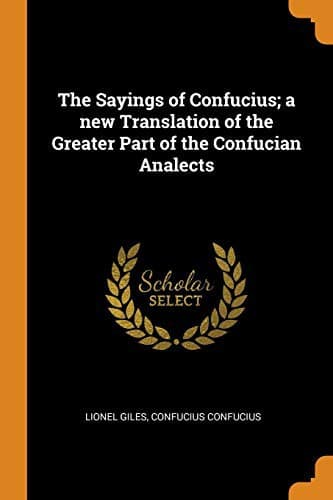
The Sayings of Confucius: A New Translation of the Greater Part of the Confucian AnalectsConfucius
ReligionEastern
The Sayings of Confucius: A New Translation of the Greater Part of the Confucian Analects
Confucius
Ethics -- China; Philosophy, Chinese
the ideas and the standards of others, he was not blind to the danger
of liberty degenerating into license. The new fetters, therefore,
that he forged for mankind were those of an iron self-discipline and
self-control, unaccompanied, however, by anything in the shape of
bodily mortification, a practice which he knew to be at once more showy
and less troublesome than the discipline of the mind.
Another charge not infrequently heard is one of a certain repellent
coldness of temperament and stiffness of demeanour. The warrant for
such a statement is not so readily forthcoming, unless indeed it is
to be found in the stiff and repellent style which characterises some
translations of his sayings. In the Analects we are told the exact
opposite of this. The Master, we read there, was uniformly cheerful
in demeanour, and he evidently unbent to quite an unusual extent with
his disciples, considering the respect and deference universally shown
to age and learning in China. Is it at all conceivable that a man of
cold and unlovable temper should have attracted round him hundreds
of disciples, with many of whom he was on terms of most intimate
intercourse, meeting them not only in the lecture-room, as modern
professors meet their classes, but living with them, eating, drinking,
sleeping and conversing with them, until all their idiosyncrasies,
good or bad, were better known to him than to their own parents? Is it
explicable, except on the ground of deep personal affection, that he
should have been followed into exile by a faithful band of disciples,
not one of whom is known ever to have deserted or turned against him?
Is coldness to be predicated of the man who in his old age, for once
losing something of his habitual self-control, wept passionately for
the death of his dearly loved disciple Yen Hui, and would not be
comforted?
Public-domain text, read in full here on John Shaqi.
Reviews
Reviews
No reviews yet
Be the first to share your thoughts on this work.
Join the Discussion
Join the discussion
Sign in to leave a comment or review.
Sign InorCreate an account