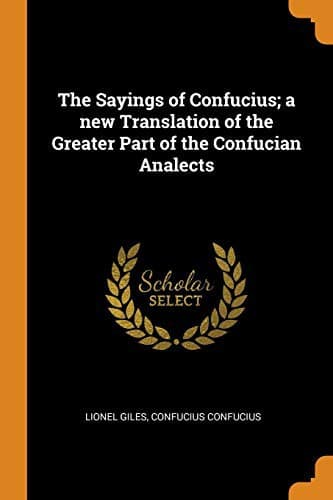
The Sayings of Confucius: A New Translation of the Greater Part of the Confucian AnalectsConfucius
ReligionEastern
The Sayings of Confucius: A New Translation of the Greater Part of the Confucian Analects
Confucius
Ethics -- China; Philosophy, Chinese
Even the disciples seem to have been in danger of
overlooking the whole in their admiration of the parts. It needed the
penetration of Tsêng Tzŭ to tell them that the Master's Way was, after
all, simple in its diversity, and might be summed up in two words: duty
to oneself and charity to one's neighbour. Unhappily, owing to the
misinterpretation of these important words, the beautiful simplicity of
the Confucian doctrine has long passed unrecognised.
For what has been, and is perhaps even now, the prevailing conception
of Confucius in the West? Does not the name conjure up in most minds
the figure of a highly starched philosopher, dry, formal, pedantic,
almost inhuman in the unimpeachable correctness of his personal
conduct, rigid and precise in his notions of ceremonial, admirable
no doubt in his sentiments, but always more a man of words than of
deeds? He has been constantly accused of laying undue weight on things
external, of undervaluing natural impulses of the heart. "Propriety,"
says Legge, "was a great stumbling-block in the way of Confucius. His
morality was the result of the balancings of his intellect, fettered by
the decisions of men of old, and not the gushings of a loving heart,
responsive to the promptings of Heaven, and in sympathy with erring and
feeble humanity." It is high time that an effective protest was made
against such an amazing piece of misrepresentation. With bitter truth
we may retort that "propriety"--that is, the Chinese word _li_ which
has been cruelly saddled with this absurd rendering--has indeed been
a stumbling-block, but a stumbling-block not so much to Confucius as
to Dr. Legge himself. The whole tenor of the Master's teaching cries
aloud against such wilful and outrageous distortion. Any one who reads
the sayings carefully will soon discover that this accusation is not
only libellous but grotesque in its remoteness from the truth. If there
is one thing more than another which distinguishes Confucius from the
men of his day, it is the supreme importance which he attached to
_jên_, the feeling in the heart, as the source of all right conduct,
the stress which he laid on the internal as opposed to the external,
and even on motives rather than outward acts, except in so far as
these might be taken as an index to character. Over and over again
he gave proof of the highest and noblest moral courage in ignoring
the narrow rules of conventional morality and etiquette when these
conflicted with good feeling and common sense, and setting up in their
stead the grand rule of conscience which, by asserting the right of
each individual to judge such matters for himself, pushed liberty to
a point which was quite beyond the comprehension of his age. So far
from being "fettered by the decisions of men of old," it was his hand
that valiantly essayed to strike the fetters of bigotry and prejudice
from the necks of his countrymen. But whilst declining to be bound by
Public-domain text, read in full here on John Shaqi.
Reviews
Reviews
No reviews yet
Be the first to share your thoughts on this work.
Join the Discussion
Join the discussion
Sign in to leave a comment or review.
Sign InorCreate an account