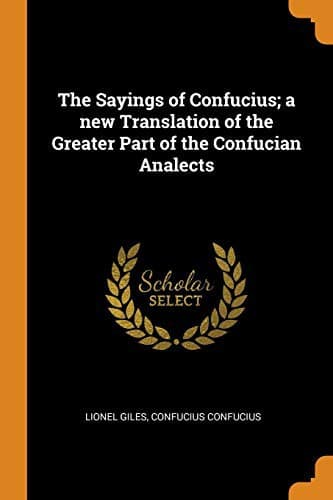
The Sayings of Confucius: A New Translation of the Greater Part of the Confucian AnalectsConfucius
ReligionEastern
The Sayings of Confucius: A New Translation of the Greater Part of the Confucian Analects
Confucius
Ethics -- China; Philosophy, Chinese
The Confucian theory of man's social obligations rests first and
foremost on the fact that he forms part of a great social machine--an
aggregation of units, each of which is called a family. The family, in
Chinese eyes, is a microcosm of the Empire, or rather, since the family
is chronologically prior to the State, it is the pattern on which the
greater organism has moulded itself. The feudal system under which
Confucius lived naturally accentuated the likeness. The Emperor had,
in theory at least, paternal authority over his feudal princes, who
in turn, standing to one another in the relation of elder and younger
brothers, were regarded as the fathers of their respective peoples.
Now, the way to ensure that a machine as a whole may run smoothly and
well, is to see that each part shall fulfil its own function in proper
subordination to the rest. How is this result achieved in the family?
Obviously through the controlling will of the father, who has supreme
authority over all the other members. But this authority is not by any
means the mere brute force of a tyrant. It is based firstly on the
natural order of things, whereby the father is clearly intended to be
the protector of his children; and secondly, as a consequence of this,
on the love and respect which will normally spring up in the minds of
the children for their protector. Such is the genesis of filial piety,
which plays so large a part in Chinese ethics. It is quite untrue,
however, to say with Mr. Jennings, that no corresponding parental
duties are recognised by Confucius, as the following anecdote may
serve to show. During the sage's short period of office as Minister
of Crime, a father came to him bringing some serious charge against
his son. Confucius kept them both in prison for three months, without
making any difference in favour of the father, and then let them go.
The Minister Chi Huan remonstrated with him for this, and reminded him
of his saying, that filial duty was the first thing to be insisted on.
"What hinders you now from putting this unfilial son to death as an
example to all the people?" Confucius' reply was, that the father had
never taught his son to be filial, and that therefore the guilt really
rested with him.
Public-domain text, read in full here on John Shaqi.
Reviews
Reviews
No reviews yet
Be the first to share your thoughts on this work.
Join the Discussion
Join the discussion
Sign in to leave a comment or review.
Sign InorCreate an account