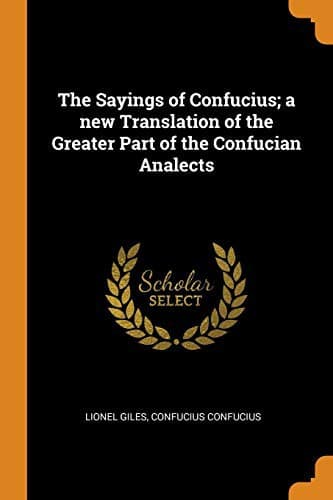
The Sayings of Confucius: A New Translation of the Greater Part of the Confucian AnalectsConfucius
ReligionEastern
The Sayings of Confucius: A New Translation of the Greater Part of the Confucian Analects
Confucius
Ethics -- China; Philosophy, Chinese
For the harmonious working of a family, then, we need respect for
authority on one side, and self-sacrifice on the other. The father's
object must be entirely altruistic--the good of his family. Then
only will he be doing his duty as a father, just as a son is not
doing his duty unless he shows honour and obedience to his parents.
The all-important element which makes possible the working of the
family machine, the lubricating oil that eases the bearings, is not
merely filial piety without any corresponding feeling on the part
of the parent, but rather a certain subtle principle of harmony and
self-control permeating every member of the family group, which
restrains egoistic propensities and promotes the common good. This is
the Chinese term _li_, which in this sense of a quality of the soul
is hardly translatable by any single word or combination of words,
but is certainly not to be rendered by any such atrocious phrase as
"the rules of propriety."[3] Now Confucius saw that the same general
principles which govern the family are applicable also to that greatest
of families, the State. Here we have the Emperor, in whose hands the
supreme authority must lie, exercising functions exactly analogous to
those of the father of a family. But if his is the supreme authority,
his must also be the supreme responsibility. Veneration and respect
are his due, but only because he identifies himself with the good of
the people. In public affairs, just as in the home, there must be
that same principle of harmony to regulate the relations of governor
and governed, otherwise the machine will not work. There must be _li_
here as well, but as it is not possible for the sovereign to maintain
with his subjects the personal intimacy which unites a father and
his sons, it is necessary to fall back upon symbols, and to give
outward and visible expression to the inward sentiments of loyalty and
respect which should animate the breast of each member of the nation.
These symbols are the rites and ceremonies of which Confucius was
considered such a past-master. He saw indeed their full importance
as symbols, but he also knew that, divorced from the inward feeling,
they were meaningless and without value. In this way it is easy to see
how the word _li_, as a human attribute, acquired its various shades
of meaning, from the harmony in the soul which prompts action in
accordance with true natural instincts, down to ordinary politeness and
good manners--also an indispensable lubricant in the lesser dealings of
life between man and man.
Public-domain text, read in full here on John Shaqi.
Reviews
Reviews
No reviews yet
Be the first to share your thoughts on this work.
Join the Discussion
Join the discussion
Sign in to leave a comment or review.
Sign InorCreate an account