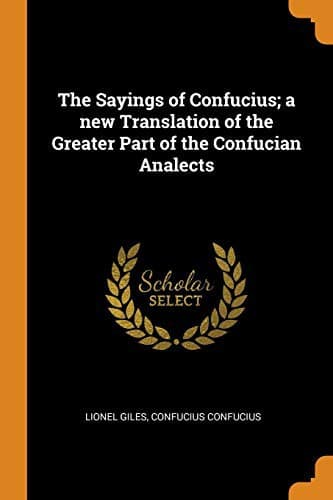
The Sayings of Confucius: A New Translation of the Greater Part of the Confucian AnalectsConfucius
ReligionEastern
The Sayings of Confucius: A New Translation of the Greater Part of the Confucian Analects
Confucius
Ethics -- China; Philosophy, Chinese
The Master said: A man of inward virtue[27] will have virtuous words
on his lips, but a man of virtuous words is not always a virtuous man.
The man of perfect goodness[27b] is sure to possess courage, but the
courageous man is not necessarily good.
Can true love be anything but exacting? How can our sense of duty allow
us to abstain from admonition?
The nobler sort of man tends upwards; the baser sort tends downwards.
The princely type of man is modest in his speech, but liberal in his
performance.
The princely man has three great virtues, which I cannot claim for
myself. He is truly benevolent, and is free from care; he is truly
wise, and is free from delusions; he is truly brave, and is free from
fear.--Nay, replied Tzŭ Kung, these virtues are our Master's own.[27]
The Master said: Is not he a sage who neither anticipates deceit nor
suspects bad faith in others, yet is prompt to detect them when they
appear?
Some one asked: How do you regard the principle of returning good for
evil?--The Master said: What, then, is to be the return for good?
Rather should you return justice for injustice, and good for good.[28]
Tzŭ Lu asked about the conduct of the princely man.[29] The Master
said: He cultivates himself so as to gain in self-respect.--Does he
rest content with that?--He cultivates himself, was the reply, so as to
give happiness to others.--And is he content with that?--He cultivates
himself so as to confer peace and prosperity on the whole people.
By self-cultivation to confer peace and prosperity on the whole
people!--was not this the object which Yao and Shun still laboured to
attain?
Tzŭ Kung asked for advice on the practice of moral virtue. The Master
replied: If an artisan wants to do his work well, he must begin by
sharpening his tools. Even so, among the great men of your country, you
should serve the wise and good, and make friends of men who have this
moral virtue.
The Master said: The higher type of man makes a sense of duty the
groundwork of his character, blends with it in action a sense of
harmonious proportion, manifests it in a spirit of unselfishness, and
perfects it by the addition of sincerity and truth. Then indeed is he a
noble character.
The higher type of man seeks all that he wants in himself; the inferior
man seeks all that he wants from others.
The higher type of man is firm but not quarrelsome; sociable, but not
clannish.
The wise man does not esteem a person more highly because of what he
says, neither does he undervalue what is said because of the person who
says it.
Tzŭ Kung asked, saying: Is there any one maxim which ought to be acted
upon throughout one's whole life?--The Master replied: Surely the maxim
of charity[30] is such:--Do not unto others what you would not they
should do unto you.
Public-domain text, read in full here on John Shaqi.
Reviews
Reviews
No reviews yet
Be the first to share your thoughts on this work.
Join the Discussion
Join the discussion
Sign in to leave a comment or review.
Sign InorCreate an account