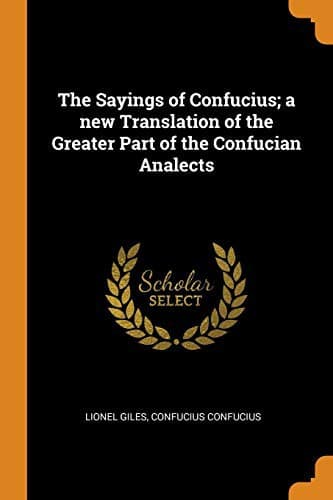
The Sayings of Confucius: A New Translation of the Greater Part of the Confucian AnalectsConfucius
ReligionEastern
The Sayings of Confucius: A New Translation of the Greater Part of the Confucian Analects
Confucius
Ethics -- China; Philosophy, Chinese
[23] Confucius here, as in general, suits his reply to the questioner.
In answering Yen Yüan, the model disciple, he had gone to the very
root of the matter, making it clear that the essence of true goodness
has little or nothing to do with externals. To Chung Kung, who was
less advanced and doubtless somewhat lacking in grace or dignity
of demeanour, he gives more superficial advice, but winds up by
enunciating the Golden Rule, which is the best practical manner of
manifesting inward goodness of heart.
[24] There seems to be a play on this word which cannot be brought out
in translation.
[25] This probably means that he will not rely on words alone in
judging of character.
[26] Being too purely negative.
[27] It is almost impossible, here and in other passages, to make any
real distinction of meaning between _te_, the manifestation of eternal
principles in the soul of man, and _jên_, natural goodness of heart,
though the former, being more universal and abstract, may be said to
include the latter, which generally implies a certain relation to one's
fellow-men.
[28] The principle of returning good for evil, which is here apparently
represented as a well-known ethical doctrine, was first enunciated, so
far as we know, by Lao Tzŭ. Confucius rejects this vain idealism, and
advocates the much sounder and more practical basis for society given
in the text.
[29] Here chün tzŭ seems almost to denote an actual prince, not merely
a man with princely qualities.
[30] Legge translates _shu_ "reciprocity," apparently for no other
reason than to explain the maxim that follows. But it really stands
for something higher than the strictly utilitarian principle of _do ut
des_. Both here and in another famous passage (see p. 118) it is almost
equivalent to _jên_, goodness of heart, only with the idea of altruism
more explicitly brought out. It connotes sympathetic consideration for
others, and hence the best rendering would seem to be "loving-kindness"
or "charity." The concluding maxim is really nothing more nor less than
the Golden Rule of Christ, though less familiar to us in its negative
form.
[32] The Chinese have a proverb: "A man must insult himself before
others will."
[33] A good example of the fluctuating content of the term _chün tzŭ_,
which in the disciple's question implies morality without reference to
rank, and in the Master's reply rank and authority without definite
moral qualities.
CONFUCIUS' ESTIMATE OF OTHERS
The Master said: I may talk all day to Hui without his putting in
a word of criticism or dissent--just as though he were deficient
in understanding. But after he has left me, I find, on examining
his private conduct, that he knows for all that how to exemplify my
teaching. No! Hui is not deficient in understanding.
Public-domain text, read in full here on John Shaqi.
Reviews
Reviews
No reviews yet
Be the first to share your thoughts on this work.
Join the Discussion
Join the discussion
Sign in to leave a comment or review.
Sign InorCreate an account