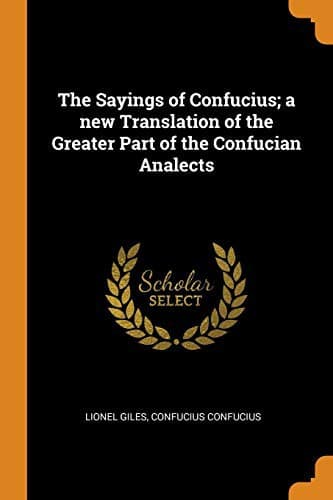
The Sayings of Confucius: A New Translation of the Greater Part of the Confucian Analects — John Shaqi
The Sayings of Confucius: A New Translation of the Greater Part of the Confucian AnalectsConfucius
ReligionEastern
The Sayings of Confucius: A New Translation of the Greater Part of the Confucian Analects
Confucius
Ethics -- China; Philosophy, Chinese
Tzŭ Kung asked, saying: What, Sir, is your opinion of me?--I would
liken you, Tz‘ŭ, replied the Master, to a vessel limited in its
function.--What sort of vessel? asked Tzŭ Kung.--A richly ornamented
sacrificial vessel, was the reply.[1]
Some one remarked that Yung had goodness of heart but no cleverness of
speech.--The Master said: Of what use is cleverness of speech? Those
who are always ready to assail others with their tongue are sure to
make themselves disliked. As to Yung's goodness of heart I have no
certain knowledge; but how would he benefit by having cleverness of
speech?
The Master said: My teaching makes no head-way. How and if I were to
board a raft and float away over the sea? My friend Yu would come with
me, I feel sure.--Tzŭ Lu, hearing this, was glad. The Master continued:
Yu surpasses me in his love of daring, but he lacks discretion and
judgment.
Mêng Wu Po asked whether Tzŭ Lu had true moral virtue. The Master
replied: I do not know.--- Asked a second time, the Master said:
Yu might be trusted to organise the military levies of a large and
powerful State, but whether he is possessed of true virtue I cannot
say.--And what is your opinion with regard to Ch‘iu?--The Master said:
Ch‘iu might be entrusted with the government of a district numbering a
thousand households or a hundred war-chariots, but whether he has true
virtue I cannot say.--And Ch‘ih, what of him?--The Master said: Ch‘ih
might be employed to stand in his official dress at a royal levee and
converse with the visitors and guests; whether he has true virtue I
cannot say.[2]
The Master addressing Tzŭ Kung said: Which of the two is the better
man, you or Hui?--Tzŭ Kung replied: How can I venture to compare myself
with Hui? Hui hears one point and promptly masters the whole. I hear
one point and am only able to feel my way to a second.--The Master
agreed: No, you are not equal to Hui; neither of us two[3] is equal to
Hui.
Tsai Yü used to sleep during the day. The Master said: Rotten wood
cannot be carved, walls made of dirt and mud cannot be plastered:
--what is the good of reprimanding Yü? At first, he continued, my way
of dealing with others was to listen to their words and to take their
actions upon trust. Now, my way is to listen to what they say and then
to watch what they do. This change in me is owing to Yü.
The Master said: I have never yet met a really strong character.--Some
one suggested Shên Ch‘êng.--The Master said: Ch‘êng is a slave to his
passions. How can he possess strength of character?
Tzŭ Kung said: I am anxious to avoid doing to others that which I
would not have them do to me. The Master said: Tz‘ŭ, you have not got
as far as that.
The Master said of Tzŭ Ch‘an[4] that he had four of the qualities of
the princely man:--in his personal demeanour he was grave, in serving
those above him he was attentive, in his care for the people he was
kind, in his ordering of the people he was just.
Public-domain text, read in full here on John Shaqi.
Reviews
Reviews
No reviews yet
Be the first to share your thoughts on this work.
Join the Discussion
Join the discussion
Sign in to leave a comment or review.
Sign InorCreate an account