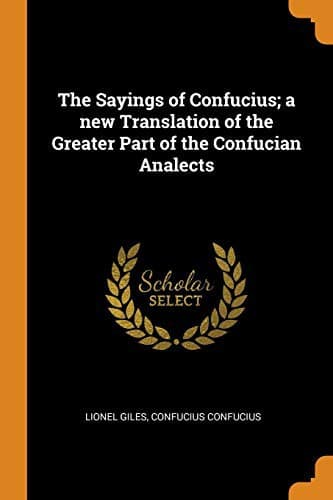
The Sayings of Confucius: A New Translation of the Greater Part of the Confucian AnalectsConfucius
ReligionEastern
The Sayings of Confucius: A New Translation of the Greater Part of the Confucian Analects
Confucius
Ethics -- China; Philosophy, Chinese
[6] A minister of the Wei State in the seventh century B.C. In the
revolution referred to the prince was driven from his throne, but
afterwards reinstated through the "stupidity," that is to say, the
unwavering loyalty and devotion of Ning.
[7] These were brothers, celebrated for their protest against the
overthrow of the Yin dynasty. Rather than live under the rule of the
new sovereign, the great and virtuous Wu Wang, they wandered away
into the mountains to perish of cold and hunger. This fidelity to the
cause of Chou Hsin, one of the bloodiest and most infamous tyrants in
history, seems a shade more quixotic than the conduct of those who
espoused for so long the fallen fortunes of the house of Stuart.
[8] This was a young man who, if legend may be trusted, died more
heroically than he lived. He agreed to meet a girl under a bridge, but,
woman-like, she failed to keep her appointment. Though the water was
rising rapidly, her lover waited on, unwilling to quit his post, and
finally clung to a pillar until he was drowned.
[9] This is the man whom Confucius, according to Wade (see p. 73),
ranked below Tzŭ Kung!
[10] Po Niu is said to have been suffering from leprosy, and therefore
he would not allow visitors to enter his room.
[11] Few will see anything harmful in this anecdote as told by
Confucius. Yet it is actually made to figure in the general charge
of insincerity and untruthfulness brought against him by Legge. "The
action was gallant," he says, "but the apology for it was weak and
unnecessary. And yet Confucius saw nothing in the whole but matter for
praise." In the first place, Legge entirely ignores the possibility
that Mêng Chih-fan was really speaking the truth. But even if it were
otherwise, Confucius' only comment is that he was "no braggart." Surely
it is an overstrained morality that could be offended by this.
[12] Compare Moltke's motto: "Erst wägen, dann wagen." Tzŭ Lu was noted
for his reckless bravery. Evidently jealous of the praise bestowed
on Yen Yüan, he makes a delightfully artless attempt to secure some
recognition for himself, but only draws down a reproof. The Master's
relations with this vain, impulsive, good-hearted disciple often remind
one of those subsisting between Dr. Johnson and Goldsmith.
[13] T‘ai Po was the direct heir to his father's throne, but knowing
that the latter wished to be succeeded by his youngest son (the father
of the future Wên Wang, the virtual founder of the Chou dynasty), he
went into voluntary exile among the barbarous tribes of the south, but
kept the motives of his conduct to himself, and thus obtained no credit
for his self-sacrifice.
[14] The "Great Yü," who in the reign of the Emperor Yao laboured
incessantly for eight years to control the disastrous inundations of
the Yellow River, himself became Emperor after the death of Yao's
successor Shun, and founded the Hsia dynasty (2205-1766 B.C.).
Public-domain text, read in full here on John Shaqi.
Reviews
Reviews
No reviews yet
Be the first to share your thoughts on this work.
Join the Discussion
Join the discussion
Sign in to leave a comment or review.
Sign InorCreate an account