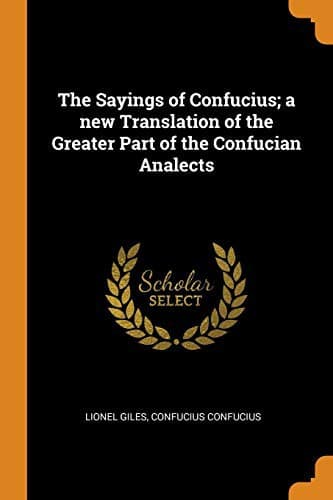
The Sayings of Confucius: A New Translation of the Greater Part of the Confucian AnalectsConfucius
ReligionEastern
The Sayings of Confucius: A New Translation of the Greater Part of the Confucian Analects
Confucius
Ethics -- China; Philosophy, Chinese
[15] A quotation from the Book of Poetry, a collection of some 300
ancient ballads said to have been selected and arranged by Confucius
himself, and hence raised to the dignity of a "classic."
[16] This must have been said by Confucius after his return from exile,
when many of his followers were dead or in other parts of the Empire.
Ch'en and Ts'ai are particularly mentioned because it was on the road
between these two small states that he met with the most perilous
adventure of his life, being surrounded by hostile troops and cut off
from all supplies for the space of seven days (see p. 115). It is not
quite clear whether the next sentence should not be taken as a note
added by the compiler, giving the names of those who were with the
Master on this journey.
[17] By criticism or questioning. Cf. p. 71.
[18] On hsiao, occurring in another treatise, Mr. Ku Hung-ming has the
following note: "The word in the text does not mean merely a filial
son, but has the meaning of the Latin 'pius'--pious in its full sense,
reverential to God, dutiful to parents, good, faithful and orderly in
all the relations of life."
[19] "This prediction was verified. When Confucius returned to Lu from
Wei, he left Tzŭ Lu and Tzŭ Kao engaged there in official service.
Troubles arose. News came to Lu, B.C. 479, that a revolution was in
progress in Wei, and when Confucius heard it, he said, 'Ch‘ai will come
here, but Yu will die,' So it turned out. When Tzŭ Kao saw that matters
were desperate he made his escape, but Tzŭ Lu would not forsake the
chief who had treated him well. He threw himself into the mêlée and was
slain."--Legge, _Life of Confucius_.
[20] This was the disciple by whoso agency Confucius was finally
restored to Lu. But Confucius was the last man to let private
considerations stand in the way when public interests were involved
and a crying evil had to be redressed. "Beating the drum" has no
reference, as Legge thinks, to "the practice of executing criminals in
the market-place." It was simply the recognised signal in warfare for
advancing to the attack, gongs being used to sound the retreat.
[21] A member of the ambitious family which was scheming to get the
whole power of the dukedom into its own hands. The two disciples here
mentioned had recently been enlisted in its service, and Chi Tzŭ-jan is
anxious to find out how far they can be relied upon in case of need.
Confucius sees through his nefarious designs.
CONFUCIUS ON HIMSELF
The Master: I will not be grieved that other men do not know me: I will
be grieved that I do not know other men.
At fifteen, my mind was bent on learning. At thirty, I stood firm. At
forty, I was free from delusions. At fifty, I understood the laws of
Providence. At sixty, my ears were attentive to the truth. At seventy,
I could follow the promptings of my heart without overstepping the mean.
Public-domain text, read in full here on John Shaqi.
Reviews
Reviews
No reviews yet
Be the first to share your thoughts on this work.
Join the Discussion
Join the discussion
Sign in to leave a comment or review.
Sign InorCreate an account