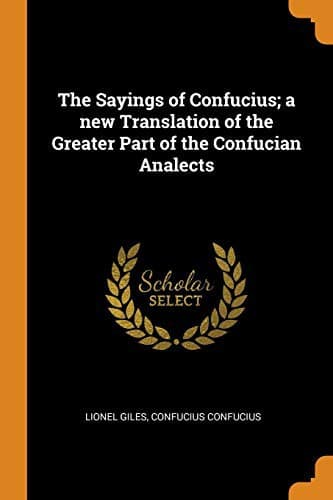
The Sayings of Confucius: A New Translation of the Greater Part of the Confucian Analects — John Shaqi
The Sayings of Confucius: A New Translation of the Greater Part of the Confucian AnalectsConfucius
ReligionEastern
The Sayings of Confucius: A New Translation of the Greater Part of the Confucian Analects
Confucius
Ethics -- China; Philosophy, Chinese
Tzŭ Kung was for doing away with the customary sacrifice of a sheep on
the first day of the month. The Master said: Ah, Tz‘ŭ, you grudge the
loss of a sheep, but I grudge the loss of a ceremony.
The Master said: In any hamlet of a dozen houses you will surely find
men as honest and conscientious as myself, though they may not be so
devoted to ethical study.
The Master having gone to visit Nan Tzŭ,[1] Tzŭ Lu was displeased.
Thereupon Confucius swore a solemn oath, saying: In whatsoever I have
sinned, may I be abominable in the sight of God!
The Master said: My function is to indicate rather than to originate.
Regarding antiquity as I do with trust and affection, I would venture
to compare myself with our ancient patriarch P‘êng Tsu.[2]
The unpretentious hiving of wisdom, patient self-cultivation, and
untiring instruction of others--to which of these can I make any claim?
The failure to cultivate virtue, the failure to examine and analyse
what I have learnt, the inability to move towards righteousness after
being shown the way, the inability to correct my faults--these are the
causes of my grief.
Alas! what a falling-off is here! Long is it since I dreamt of Chou
Kung.[3]
There is no one, from the man who brings me dried meat as payment
upwards, to whom I have refused my instruction.
I do not expound my teaching to any who are not eager to learn; I do
not help out any one who is not anxious to explain himself; if, after
being shown one corner of a subject, a man cannot go on to discover the
other three, I do not repeat the lesson.
If the pursuit of riches were a commendable pursuit, I would join in
it, even if I had to become a chariot-driver for the purpose. But
seeing that it is not a commendable pursuit, I engage in those which
are more to my taste.[4]
The Duke of Shê questioned Tzŭ Lu about Confucius. Tzŭ Lu made no
reply. The Master said to him afterwards: Why did you not say: "He
is a man whose zeal for self-improvement is such that he forgets to
eat; whose happiness in this pursuit is so great that he forgets his
troubles and does not perceive old age stealing upon him"?
The Master said: In me, knowledge is not innate. I am but one who loves
antiquity, and is earnest in the study of it.
If I am walking with two other men, each of them will serve as my
teacher. I will pick out the good points of the one and imitate them,
and the bad points of the other and correct them in myself.
My disciples, do you think that I have any secrets? I have no secrets
from you. It is my way to do nothing without communicating it to you,
my disciples.
There are men, I daresay, who act rightly without knowing the reason
why, but I am not one of them. Having heard much, I sift out the good
and practise it; having seen much, I retain it in my memory. This is
the second order of wisdom.[5]
In literary accomplishments I am perhaps equal to other men; but I have
not yet succeeded in exhibiting the conduct of the princely man in my
own person.
Public-domain text, read in full here on John Shaqi.
Reviews
Reviews
No reviews yet
Be the first to share your thoughts on this work.
Join the Discussion
Join the discussion
Sign in to leave a comment or review.
Sign InorCreate an account