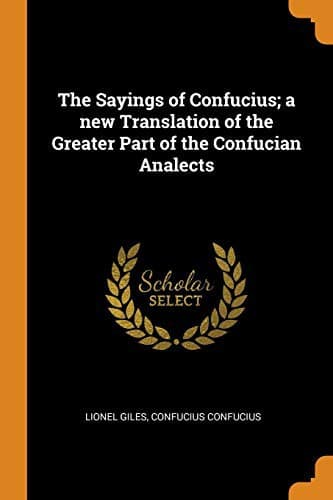
The Sayings of Confucius: A New Translation of the Greater Part of the Confucian AnalectsConfucius
ReligionEastern
The Sayings of Confucius: A New Translation of the Greater Part of the Confucian Analects
Confucius
Ethics -- China; Philosophy, Chinese
As an arbiter in litigation I am no better than other men. But surely
the grand object to achieve is that there shall be no litigation at
all.[12]
Wei-sheng Mou,[13] addressing Confucius, said: Ch‘iu, why is it you
keep hopping about thus from place to place? Is it not in order to
show off your fine rhetoric?--Confucius replied: I do not allow myself
to indulge in fine rhetoric; no, it is because I consider obstinacy a
fault.[14]
The Master said: There are none who know me for what I am.--Tzŭ Kung
said: How is it, Sir, that none know you?--The Master replied: I make
no complaint against Heaven, neither do I blame my fellow-men. In the
study of virtue I begin at the bottom and tend upwards.[15] Surely
Heaven knows me for what I am.
Tz‘ŭ, do you look upon me as a man who has studied and retained a
mass of various knowledge?--I do, he replied. Am I wrong?--You are
wrong, said the Master. All my knowledge is strung on one connecting
thread.[16]
I used to spend whole days without food and whole nights without sleep,
in order to meditate.
But I made no progress. Study, I found, was better.
Pi Hsi[17] sent an invitation to Confucius, and the Master wished to
go. Tzŭ Lu, however, said: Once upon a time, Sir, I heard you say
that the nobler sort of man would not enter into intimacy with one
who laid himself out to do wrong. Now Pi Hsi has raised the standard
of rebellion in Chung-mou. How can you think of going thither?--True,
replied the Master. Those were my words. But is there not a saying:
"The hard may be rubbed without losing its substance; the white may be
steeped without losing its purity"? Am I then a bitter gourd--fit only
to be hung up and not eaten?
[1] The wife of the Duke of Wei, notorious for her intrigues, and even
accused of incest. Needless to say, Chinese commentators are at great
pains to explain away this incident in the life of the sage.
[2] A grandson of the legendary Emperor Chuan Hsü. He is said to have
been over 800 years old when he disappeared into the west in the
eleventh century B.C. The last words in the text are taken by some to
mean "our patriarchs Lao Tzŭ and P‘êng Tsu"--Lao Tzŭ being the founder
of Taoism, who is also, by the way, alleged to have disappeared at an
advanced age into the west.
[3] One of the most revered names in Chinese history. The younger
brother of Wu Wang, he helped materially by his wise counsels to
establish the dynasty of Chou. He drew up a legal code, purified the
morals of the people, and devoted himself wholly to the welfare of
the State. Confucius in the reforming zeal of his younger days had
an ardent desire to see the principles and institutions of Chou Kung
brought into general practice.
Public-domain text, read in full here on John Shaqi.
Reviews
Reviews
No reviews yet
Be the first to share your thoughts on this work.
Join the Discussion
Join the discussion
Sign in to leave a comment or review.
Sign InorCreate an account