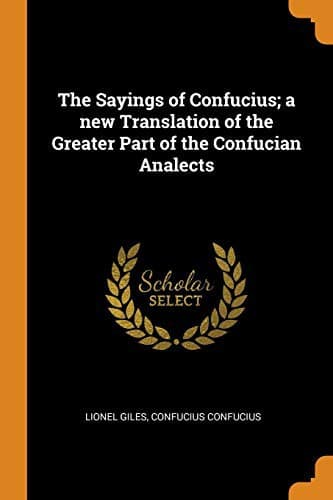
The Sayings of Confucius: A New Translation of the Greater Part of the Confucian AnalectsConfucius
ReligionEastern
The Sayings of Confucius: A New Translation of the Greater Part of the Confucian Analects
Confucius
Ethics -- China; Philosophy, Chinese
[4] Legge and others (including even Mr. Ku Hung-ming) make the sense
out to be: "If there were any prospect of my being successful in the
search for riches, I would not hesitate to pursue them by any means
in my power." Thus translated, the Master's saying is grotesquely at
variance with the whole trend of his conduct and the essential spirit
of his teaching. Curiously enough, too, there is nothing in the Chinese
itself, so far as I can see, to justify such a startling interpretation.
[5] That is to say, the wisest men are those who act intuitively,
without having to find their way by any conscious mental process.
Confucius disclaims any such intuitive perception of right and wrong
in his own case, and confesses that he is obliged to rely largely on
objective experience, as acted upon by the critical and receptive
powers of his mind. The saying has a distinctly Taoist flavour.
[6] It is not known exactly what these were--a collection of prayers, a
book of rituals for the dead, or panegyrics on the departed.
[7] Confucius speaks of prayer in the sense made familiar to us by
Coleridge's line: "He prayeth best who loveth best." In this higher
sense his whole life had been one long prayer, and he refuses any
mediation between himself and God. Could antagonism to the ritualistic
spirit be carried much farther than this?
[8] This saying well illustrates the Master's attitude in regard to
ceremonies. He was no stickler for mere outward conformity to rule, so
long as the inner meaning of the ceremony was not affected. Now the
salutation of the Prince was simply intended to be a way of expressing
heart-felt loyalty and respect, and it was only because the new
position seemed less respectful that Confucius opposed the change.
[9] See note on p. 44.
[10] Question and answer are of course parabolical. The enthusiastic
young disciple thinks that his Master, in taking no steps to obtain
official employment, is guilty of "hiding his jewel in a casket," or,
as we should say, "his light under a bushel." Confucius, however, had
a great sense of the responsibility of office, and was loth to thrust
himself forward uninvited. His chance came at last after fifteen years
of waiting, when Duke Ting appointed him governor of the town of
Chung-tu.
[11] Another proof, if one were needed, that Confucius' instincts were
all for simplicity and not elaboration in ceremonies.
[12] Said by Confucius when he was Minister of Justice in Lu.
[13] Evidently an older man, from his use of the personal name, not to
speak of his disrespectful tone.
[14] Confucius, like other great men, was not exempt from the usual
fate of seeing his actions derided and his motives misunderstood. Here
we have a gibe thrown at his wandering from state to state, for the
purpose, it is insinuated, of making a living by his wits. The answer
is, that to have remained in Lu or any other state where he was plainly
not wanted, would have been merely stupid persistency.
Public-domain text, read in full here on John Shaqi.
Reviews
Reviews
No reviews yet
Be the first to share your thoughts on this work.
Join the Discussion
Join the discussion
Sign in to leave a comment or review.
Sign InorCreate an account