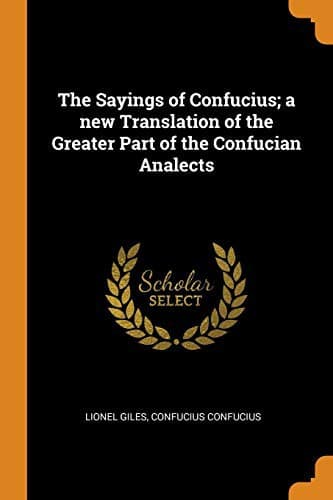
The Sayings of Confucius: A New Translation of the Greater Part of the Confucian AnalectsConfucius
ReligionEastern
The Sayings of Confucius: A New Translation of the Greater Part of the Confucian Analects
Confucius
Ethics -- China; Philosophy, Chinese
Though in making a mound I should stop when but one more basketful of
earth would complete it, the fact remains that I _have_ stopped. On the
other hand, if in levelling it to the ground I advance my work by but
one basketful at a time, the fact remains that I _am_ advancing.[15]
Alas! there are sprouting crops which never come into ear. There are
others which, having come into ear, never ripen into grain.
We ought to have a wholesome respect for our juniors. Who knows
but that by-and-by they may prove themselves equal to the men of
to-day? It is only when they reach the age of forty or fifty without
distinguishing themselves that we need no longer be afraid of them.
Words of just admonition cannot fail to command a ready assent. But
practical reformation is the thing that really matters. Words of kindly
advice cannot fail to please the listener. But subsequent meditation on
them is the thing that really matters. I can make nothing of the man
who is pleased with advice but will not meditate on it, who assents to
admonition but does not reform.
A great army may be robbed of its leader, but nothing can rob one poor
man of his will.
It is only when the cold season comes that we know the pine and cypress
to be evergreens.[16] Let a pupil join with you in self-cultivation
before you let him approach the general truths of philosophy, but let
him approach these general truths before he is allowed to form his
character for good. He should have formed his character for good before
he is allowed to make exceptions to a general rule.
When Yen Yüan died, the Master said: Alas! God has forsaken me, God has
forsaken me!
On the death of Yen Yüan, the disciples wanted to give him a sumptuous
funeral, but the Master said, Better not.[17] Nevertheless, the
disciples did give him a sumptuous funeral, whereupon the Master said:
Hui looked upon me as his father, yet I have not been able to treat him
as my son. The fault is not in me, but in you, my disciples.
Chi Lu inquired concerning men's duty to spirits. The Master replied:
Before we are able to do our duty by the living, how can we do it by
the spirits of the dead?--Chi Lu went on to inquire about death. The
Master said: Before we know what life is, how can we know what death
is?
Tzŭ Chang asked a question about clearness of mental vision. The Master
said: He whose mind is proof against the slow-soaking poison of slander
and the sharp stings of calumny, may be called clear-sighted, and
far-seeing as well.
The Master said: A man may know the three hundred odes by heart, but
if he proves himself incapable when given a post in the government, or
cannot make a speech unaided when sent on a foreign mission, of what
use to him is all his learning?
Public-domain text, read in full here on John Shaqi.
Reviews
Reviews
No reviews yet
Be the first to share your thoughts on this work.
Join the Discussion
Join the discussion
Sign in to leave a comment or review.
Sign InorCreate an account