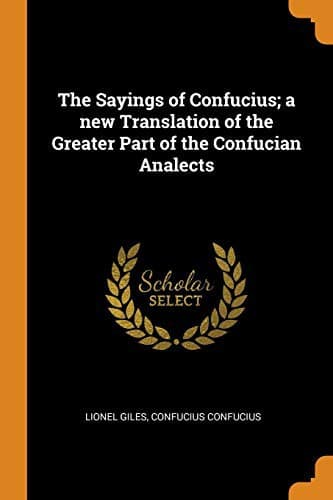
The Sayings of Confucius: A New Translation of the Greater Part of the Confucian Analects — John Shaqi
The Sayings of Confucius: A New Translation of the Greater Part of the Confucian AnalectsConfucius
ReligionEastern
The Sayings of Confucius: A New Translation of the Greater Part of the Confucian Analects
Confucius
Ethics -- China; Philosophy, Chinese
Tzŭ Hua having been sent on a mission to the Ch‘i State, Jan Ch‘iu
begged for a gift of grain for his mother. The Master said: Give her a
peck.--The disciple asking for more, he said:
Give her then a bushel.--But Jan Ch‘iu eventually gave her as much as
five hundredweight of grain. Then the Master rebuked him, saying: When
Ch‘ih went to the Ch‘i State, he was conveyed by a team of sleek horses
and was wearing costly fur garments. Now I have heard that the princely
man succours the distressed, but will not add to the opulence of the
wealthy.
Yüan Ssŭ, having been made governor of a district, was presented with
nine hundred measures of grain.[9] He declined them. The Master said:
Do not decline them. May they not be distributed among the villages and
townships of your neighbourhood?
The Master said: Who can go out of a house except by the door? In life,
why not pass likewise through the door of virtue?[10]
You may speak of higher subjects to those who rise above the average
level of mankind, but not to those who fall below it.
With coarse food to eat, water to drink, and the bended arm as a
pillow, happiness may still exist. Wealth and rank unrighteously
obtained seem to me as insubstantial as floating clouds.
The inhabitants of Hu-hsiang were unconversable people, and when
a young man from those parts came to see Confucius, the disciples
hesitated to let him in. But the Master said: When a man comes to me, I
accept him at his best, not at his worst. Why make so much ado? When a
man washes his hands before paying a visit, and you receive him in that
clean state, you do not thereby stand surety for his always having been
clean in the past.
The Master said: Is virtue then so remote? I have only to show a desire
for virtue, and lo! it is here.
The Master said: Prodigality begets arrogance,[11] parsimony begets
niggardliness. But it is better to be niggardly than arrogant.
Without due self-restraint,[12] courtesy becomes oppressive, prudence
degenerates into timidity, valour into violence, and candour into
rudeness.
Love of daring and dread of poverty lead to sedition. The man without
natural virtue, if pursued by the hatred of society, will become a
desperado.
If a man is proud and avaricious, though his other qualities may
embrace all that was fine in the character of Chou Kung, they are not
worth taking into account.
It is not easy to find a man who after three years of
self-cultivation[13] has not reached happiness.
He who is out of office should not meddle in the government.
Hot-headedness without honesty; ignorance without ingenuousness;
simplicity without sincerity:--such characters I do not understand.[14]
Pursue the study of virtue as though you could never reach your goal,
and were afraid of losing the ground already gained.
The Master said: I have not met one whose love of virtue was equal to
his love of sensual beauty.
Public-domain text, read in full here on John Shaqi.
Reviews
Reviews
No reviews yet
Be the first to share your thoughts on this work.
Join the Discussion
Join the discussion
Sign in to leave a comment or review.
Sign InorCreate an account